
Commercial Lock Rekeying Service: The Business Owner’s Guide to Access Control
- Pro On The Go Locksmith
- Aug 11
- 12 min read

What if the most effective way to secure your business after a staff transition isn't to rip out your expensive hardware, but to simply change its internal logic? You've likely invested significant capital into high-grade locks; the thought of replacing them every time an employee leaves is both stressful and financially draining. It's a common frustration for many business owners who feel caught between maintaining security and managing a budget. This is where a professional commercial lock rekeying service becomes your most strategic asset, offering a precise way to reset your security without the waste of a full hardware replacement.
We understand that managing multiple keys for different doors creates unnecessary complexity and anxiety. You need a plan that works as hard as you do. This guide will show you how professional rekeying restores your peace of mind by creating a streamlined master key system. We'll break down the technical process of adjusting internal tumblers, explain how to audit your current door hardware, and demonstrate why this method is the most cost-effective alternative to buying new locks. By the end, you'll have a clear roadmap for securing your facility and optimizing your access control with the confidence of a seasoned specialist.
Table of Contents
What is Commercial Lock Rekeying and Why Does Your Business Need It?
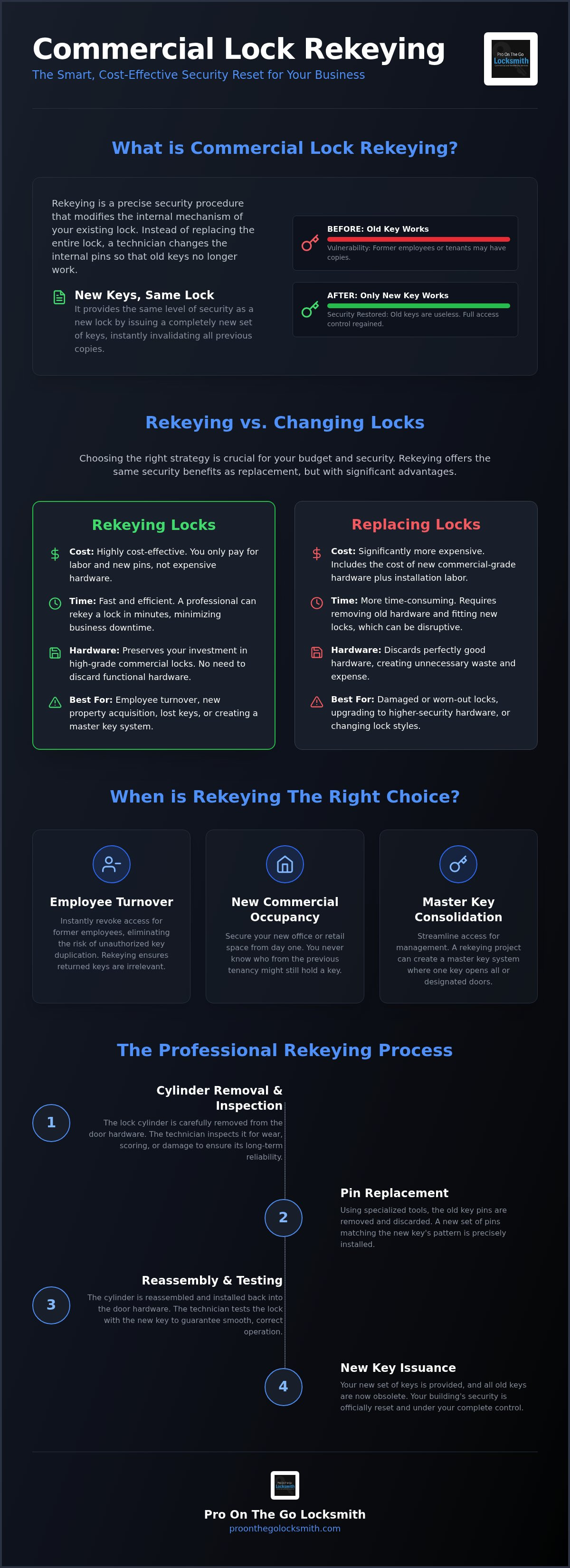
Rekeying is a strategic recalibration of your facility's security. Instead of replacing the entire lock assembly, a commercial lock rekeying service focuses on the internal cylinder. By adjusting the sequence of the internal tumblers or pins, a technician ensures that existing keys will no longer engage the mechanism. Only a new, specifically cut key will work. The heavy-duty hardware stays on the door; only the internal "logic" of the lock changes. This process provides an immediate security reset for high-traffic entry points without the disruption of a full hardware overhaul.
Businesses often choose this route because it addresses the most common security vulnerability: unauthorized key duplication. When you rekey, you're not just changing a lock. You're regaining control over who enters your building. It's a surgical approach to security that prioritizes precision over replacement. This method is particularly effective for restoring security after a master key is lost or when you need to revoke access immediately following a sensitive staff change.
Common Scenarios Requiring Commercial Rekeying
Security needs often shift faster than hardware wears out. A professional reset is necessary in several key situations:
Employee Turnover: Even if a former employee returns their key, you can't be certain they didn't make a duplicate. Rekeying eliminates that risk instantly.
New Commercial Occupancy: Moving into a new office or retail space is a high-risk period. Previous tenants, contractors, or cleaners might still hold keys to your front door.
Master Key Consolidation: If your managers are carrying a heavy ring of different keys, a rekeying project can consolidate those into a single master key system for streamlined access.
The Cost-Efficiency of Rekeying vs. Replacing
Replacing commercial-grade hardware is an expensive undertaking. Most businesses utilize Grade 1 or Grade 2 locks, which are designed to withstand hundreds of thousands of cycles. It makes little sense to discard a perfectly functional mortise lock or a complex panic bar simply because you need a new key. Rekeying preserves your investment in high-quality materials while providing the same level of security as a brand-new installation.
The savings extend to labor as well. Professional technicians can rekey a standard cylinder in a fraction of the time it takes to drill, prep, and fit new hardware. This efficiency means less downtime for your business and a lower overall invoice. By focusing on the internal pins rather than the external housing, you optimize your security budget without compromising on the safety of your assets or personnel.
The Technical Process: How a Professional Rekeying Service Works
Commercial locks are engineered for durability and high-frequency use. A professional commercial lock rekeying service doesn't just swap parts; it performs a precise diagnostic reset. The process begins with the careful removal of the lock cylinder from the door hardware. Once extracted, the technician uses a specialized tool called a plug follower to slide the "plug" (the part that rotates) out of the "housing." This step is critical. It prevents the internal springs and driver pins from collapsing, which would render the lock useless and require a complete hardware replacement.
Inside the plug, the technician finds a series of small brass pins of varying heights. These "key pins" are discarded. The technician then selects a new set of pins from a professional pinning kit that matches the bitting of the new key. By replacing these pins, the internal logic of the lock is fundamentally changed. During this process, a master technician also inspects the cylinder for wear. If the cylinder shows signs of excessive brass shavings or deep scoring, they may recommend a full replacement to ensure long-term reliability. This verification step ensures the security reset is as durable as it is effective.
Anatomy of a Commercial Lock Cylinder
High-security commercial locks utilize a sophisticated pin-and-tumbler mechanism designed for millions of cycles. The system relies on two sets of pins: the driver pins, which sit at the top and are pushed by springs, and the key pins, which rest in the plug. The shear line is the precise physical gap between the rotating plug and the stationary housing that must be perfectly cleared by all pins for the lock to turn. Precision is paramount here. Variations as small as 0.001 inches can cause "dragging," which eventually leads to key breakage or internal mechanical failure in high-traffic environments.
Tools of the Modern Master Technician
Precision requires the right equipment. Mobile technicians carry on-site pinning kits and key decoders to ensure every cut is factory-perfect. A key decoder allows the technician to read the exact depths of an existing master key, ensuring the new system integrates seamlessly with your facility's access plan. Unlike a generic hardware store duplicate, on-site key cutting utilizes code-cutting machines. These machines create keys based on original manufacturer specifications rather than tracing a worn copy. If you're managing a complex facility, professional commercial rekeying ensures your hardware operates with the same precision it had on the day it was installed.
Rekeying vs. Changing Locks: Choosing the Right Security Strategy
Choosing between a simple reset and a total hardware overhaul requires a diagnostic eye. While a commercial lock rekeying service is the most efficient path for the majority of business transitions, it isn't a universal fix. You must evaluate the physical integrity of your hardware. If your door levers are sagging or the latch doesn't consistently catch the strike plate, the internal mechanical fatigue has likely reached a point where pinning won't restore reliability. For a deeper look at these differences, you can read our professional guide on rekey vs change locks.
Functional lifespan isn't just about security; it's also about compliance and professional image. Corroded or weathered hardware doesn't just look unprofessional. It can become a liability during fire inspections. Commercial doors must operate smoothly to ensure safe egress during an emergency. If your current handles are pitted, rusted, or outdated, a full lock change provides the opportunity to bring your facility up to modern fire codes while simultaneously enhancing the aesthetic of your entryway.
When to Opt for a Full Lock Change
Strategic upgrades often demand new hardware rather than just a key change. If you're transitioning to smart locks or a centralized electronic access control system, you'll need to replace the mechanical components entirely. Another vital reason for a full change is the implementation of a restricted keyway. These systems use patented key blanks that can't be duplicated at local hardware stores. This gives you absolute control over how many copies exist. Switching to a restricted brand is a proactive move for businesses with high turnover or sensitive data areas.
Master Key System Implementation
A master key system is a tiered security architecture designed for operational efficiency. It allows a business owner to carry one key that opens every door, while managers only access specific departments and staff members are restricted to their immediate work areas. This is achieved through master pinning, where the lock cylinder contains additional pins to create multiple shear lines. It's a complex technical challenge. Poorly designed systems can lead to "cross-keying," where a lower-level key inadvertently opens a door it shouldn't. A professional technician designs these systems with future-proofing in mind. This ensures your key hierarchy can expand as your business adds new rooms or departments without requiring a total system reset.
Preparing for Your Commercial Rekeying Project
Success begins with a systematic evaluation. Before scheduling a commercial lock rekeying service, you must conduct a thorough door-by-door audit. This process identifies exactly which cylinders need a reset and which hardware requires maintenance. Most business owners focus on the front entrance; however, a secure plan accounts for every entry point. You'll need to identify specific user groups, such as general staff, cleaning crews, and management, to determine their required access levels. Mapping these requirements early prevents the need for follow-up visits and ensures your master key system works perfectly from day one.
Compliance is a critical factor in commercial security. During your project preparation, we evaluate your hardware for ADA (Americans with Disabilities Act) compliance. Commercial buildings often require lever-style handles instead of traditional knobs to ensure accessibility for all users. We also prioritize scheduling during your off-peak hours. While our mobile technicians work efficiently, performing the service when foot traffic is low minimizes disruption to your daily operations and allows for a faster, more focused security reset.
The Security Audit Checklist
A professional audit looks beyond the keyway. It treats the door as a complete system. Use this checklist to prepare for your technician's arrival:
Inventory Access Points: Document every exterior door, loading dock, and roof hatch.
Check Alignment: Inspect strike plates and door closers. If a door doesn't latch correctly, the lock won't secure the building properly.
Interior Security: Identify sensitive areas like server rooms, supply closets, or executive offices that require restricted access.
Compliance and Legal Considerations
Safety and security are inseparable. Every lock adjustment must maintain fire-code compliance, particularly regarding emergency egress. Doors must allow occupants to exit without a key or special knowledge during an emergency. It's essential to partner with a professional who understands these local regulations. Pro On The Go Locksmith operates under Florida license #HCLOC23013, ensuring all work meets state standards. Once the project is complete, you should establish a key control log. This document tracks every duplicate issued, creating a permanent record of who holds access to your facility. To get started with a professional assessment, you can schedule your commercial security audit today.
Why Choose Pro On The Go Locksmith for Commercial Locksmithing in Tampa?
Tampa's commercial landscape moves fast. From the high-rise offices in Westshore to the historic retail hubs in Ybor City, business security requires a partner who understands the local environment. When you hire our commercial lock rekeying service, you aren't just getting a technician. You're getting a licensed specialist who is deeply invested in the Tampa business community. We understand that a security breach isn't just a technical problem; it's a high-stress event that threatens your livelihood. That's why we prioritize a "we have a plan" attitude that focuses on transparency, reliability, and technical excellence.
One of our core strengths is professional entry. If you're facing a lockout, we don't immediately reach for the drill. We utilize specialized tools and techniques to bypass locks without damaging your expensive Grade 1 or Grade 2 hardware. This approach saves you the high cost of replacement and ensures your door remains as secure as the day it was installed. We bridge the gap between traditional mechanical skill and modern electronic security, ensuring your facility is protected by the best technology available.
The Mobile Locksmith Advantage
Security breaches don't wait for a convenient time. Our mobile units operate as fully functional workshops on wheels. We arrive at your location with the specialized pinning kits and high-precision key cutters needed to provide a complete commercial lock rekeying service on the spot. This eliminates the need for multiple visits and keeps your operations running smoothly. We bring the shop to you, whether you're managing a single storefront or a sprawling industrial complex. For businesses managing delivery vehicles or corporate fleets, we also provide a fast car lockout service to ensure your team stays on schedule and productive.
Restoring Your Peace of Mind
We approach every project with the mindset of a "Modern Master Technician." This means our process is diagnostic rather than just reactive. We don't just pin a lock; we evaluate the entire door assembly to ensure long-term reliability. Our communication is always transparent and honest. If a cylinder is too worn to be safely rekeyed, we'll explain the technical reasons why and offer a durable replacement option. We prioritize your time and safety above all else. It's about providing a clear, methodical plan that lowers your anxiety and secures your assets. Secure your business today with Pro On The Go Locksmith.
Securing Your Business Assets with Precision
Securing a commercial facility requires a strategy that balances ironclad protection with operational efficiency. You don't need to replace expensive hardware every time an employee leaves or a key goes missing. By focusing on the internal logic of your locks, a professional commercial lock rekeying service restores your security while preserving your budget. This approach allows you to implement a sophisticated master key system that simplifies access for your managers and limits risk across your entire Tampa facility.
Our team at Pro On The Go Locksmith brings the specialized tools and diagnostic expertise of a Modern Master Technician directly to your door. As a licensed Florida locksmith (#HCLOC23013), we prioritize transparency and precision in every project. Whether you're moving into a new space or revamping your current access control, we have a plan to keep your assets safe. Don't leave your security to chance or settle for outdated hardware management. Schedule a commercial security audit with Pro On The Go Locksmith today to ensure your building remains protected and compliant. We're ready to help you take full control of your business's safety.
Frequently Asked Questions
Is it cheaper to rekey or replace commercial locks?
Rekeying is significantly more cost-effective because it preserves your existing high-grade hardware. Since you only pay for the technician's labor and small internal pins rather than entire mortise or panic bar assemblies, the savings are substantial. This approach is the preferred method for businesses managing high turnover who need to reset security without the capital expense of new hardware. It's a strategic way to maintain Grade 1 security on a budget.
How long does it take to rekey a standard commercial door?
A standard commercial cylinder typically takes 15 to 30 minutes to rekey once the technician is on-site. This timeframe includes the removal of the cylinder, pinning for the new key, and reinstalling the hardware. For a larger project, such as a 10-door facility, you can expect a professional commercial lock rekeying service to complete the entire job in approximately three to four hours, depending on the complexity of the hardware.
Can all commercial locks be rekeyed?
Most mechanical commercial locks can be rekeyed, provided the internal cylinder is in good working condition. However, some entry-level or "disposable" locks found in residential-grade hardware aren't designed for internal servicing. If your hardware is severely corroded or the internal plug is damaged, a technician will recommend a full lock change to ensure your building's security isn't compromised by mechanical failure. We'll always perform a diagnostic check before starting the work.
What is a master key system and do I need one for my office?
A master key system is a tiered access structure where a single key opens all doors while subordinate keys are restricted to specific areas. It's highly beneficial for offices because it allows owners total access while limiting staff to their necessary work zones. We design these systems to reduce the number of keys your management team must carry, improving both convenience and security oversight. It's an essential tool for growing businesses.
Will rekeying my locks invalidate the manufacturer's warranty?
Rekeying performed by a licensed professional typically does not invalidate a manufacturer's warranty. Most commercial lock manufacturers design their products to be serviced and rekeyed throughout their lifespan. Using a commercial lock rekeying service ensures that the work meets industry standards, which protects your investment in high-quality hardware like Grade 1 levers or deadbolts. It's always best to verify specific terms with your hardware provider if you have proprietary or high-security systems.
Can I rekey my own commercial locks to save money?
You shouldn't attempt to rekey commercial locks yourself due to the high risk of damaging the sensitive internal springs and driver pins. Commercial hardware is far more complex than residential sets and requires specialized tools like plug followers and key decoders. A single mistake during reassembly can permanently "brick" the lock, leading to an expensive emergency replacement that far exceeds the cost of professional service. It's a technical task best left to specialists.
How often should a business rekey its locks?
You should rekey your locks whenever there is a change in key-holding personnel or a loss of a master key. While there isn't a fixed calendar requirement, many businesses perform a security audit and reset every two to three years as a preventative measure. This practice ensures that "key creep," where unauthorized duplicates accumulate over time, doesn't undermine your facility's physical security. Regular maintenance also allows us to inspect hardware for wear.
What happens if I lose the master key to my rekeyed system?
Losing a master key is a critical security breach that requires an immediate rekeying of every lock in the system. Because the master key grants access to all areas, your building is vulnerable until the internal pins are changed. Our technicians can quickly reset the hierarchy and issue a new master set, ensuring that the lost key is rendered useless and your security is fully restored. We have a plan to handle these high-stress situations efficiently.


