
Commercial Lock Change Service: The Business Owner’s Guide to Facility Security
- Pro On The Go Locksmith
- 3 days ago
- 12 min read

With commercial Chapter 11 bankruptcies rising by 28 percent in the first half of 2026, more Tampa business owners find themselves managing rapid property turnovers and the security risks that follow. You know that a single unaccounted-for key or a worn-out Grade 3 lock is more than a minor annoyance. It's a liability that threatens your inventory and your staff's safety. Securing your storefront or office shouldn't be a source of constant stress.
This guide explains exactly how a professional commercial lock change service secures your facility while ensuring you stay compliant with the latest ADA and 2026 fire codes. We'll break down the technical differences between rekeying and full hardware replacement, help you choose between ANSI Grade 1 and Grade 2 hardware, and show how a Master Key System can simplify your daily operations. From understanding new UL standards to minimizing downtime during mobile service, you'll learn how to maintain a high-tech, hardened facility without the typical headaches of complex key management. We'll provide the diagnostic steps needed to evaluate your current hardware and the professional insight required to upgrade your business security effectively.
Table of Contents
Securing Your Facility: When to Schedule a Commercial Lock Change Service
Commercial Grade Hardware: Understanding Security Levels and ANSI Standards
Lock Change vs. Rekeying: Finding the Right Solution for Your Facility
Advanced Access Management: Master Key Systems and Restricted Keyways
Professional Commercial Locksmith Services in Tampa: The Pro On The Go Advantage
Securing Your Facility: When to Schedule a Commercial Lock Change Service
A professional commercial lock change service involves the total replacement of the internal and external locking mechanism. It's a comprehensive security reset that goes much deeper than a simple rekeying. While residential locks might last a decade, commercial hardware on high-traffic doors requires more frequent attention. In a busy Tampa storefront, a door might cycle hundreds of times a day. This mechanical stress leads to internal fatigue. Eventually, the metal components within the lockset wear down, creating a failure point that a simple pin adjustment cannot fix.
When you move into a new office space, you're often handed a set of "inherited" keys. This is a massive security vulnerability. You have no way of knowing how many duplicates were made by previous tenants, cleaning crews, or contractors. Starting fresh with a full hardware replacement ensures that your access control begins at zero. Every key is accounted for from day one, giving you a clean slate and total peace of mind regarding who has entry to your property.
Critical Security Triggers for Businesses
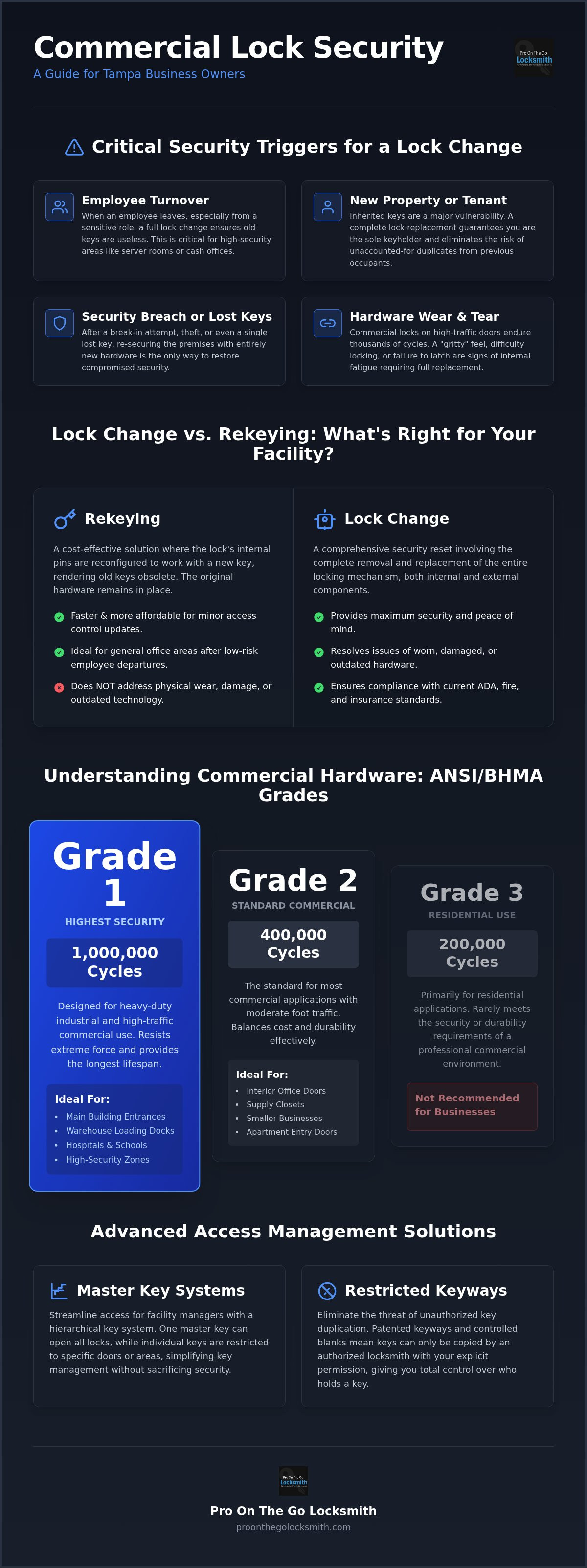
Employee turnover is the most frequent trigger for a commercial lock change service. While rekeying works for general office areas, a full hardware change is the gold standard for high-security zones like server rooms or cash offices. Physical damage is another non-negotiable factor. If a mortise lock or cylinder feels "gritty" or fails to latch properly, the internal housing is likely compromised. Additionally, local Tampa fire marshals or ADA regulations often mandate specific hardware upgrades to ensure life safety compliance. Using the correct ANSI/BHMA lock security grades ensures your facility remains both compliant and physically hardened against unauthorized entry.
The Risk of Outdated Commercial Hardware
Intruders constantly refine their bypass techniques. Older cylinders are often susceptible to bumping or picking methods that modern high-security hardware easily resists. Beyond physical entry, outdated hardware is a liability for your business insurance. If a breach occurs and your locks don't meet current industry standards, your provider might scrutinize your claim. Transitioning to restricted keyways is a proactive solution. These patented systems prevent keys from being copied at a standard hardware store kiosk. It's a diagnostic approach to security: identify the vulnerability of unauthorized duplication and resolve it with hardware that requires professional authorization for any new keys.
Commercial Grade Hardware: Understanding Security Levels and ANSI Standards
Durability in a commercial setting isn't just about the weight of the metal. It is determined by the ANSI/BHMA grading system, which serves as the benchmark for hardware performance. This system categorizes locks into three grades based on their ability to withstand physical force and repetitive use. When you schedule a commercial lock change service, understanding these grades ensures you don't overspend on low-traffic areas or underspecify for your main entrance. The grading process involves rigorous cycle testing, where machines operate the lock repeatedly until it fails. This diagnostic data allows business owners to predict the lifespan of their security investment accurately.
Grade 1 hardware is the highest level of security available for heavy-duty industrial and commercial use. It is designed to endure extreme conditions and high-frequency operation. In contrast, Grade 2 is the standard commercial grade, suitable for interior offices or smaller businesses with moderate foot traffic. Grade 3 is generally reserved for residential applications and rarely meets the requirements of a professional commercial environment. Choosing the right grade is a calculated decision that balances upfront hardware costs against long-term maintenance cycles.
Grade 1 vs. Grade 2: Which Does Your Business Need?
The choice between Grade 1 and Grade 2 depends entirely on the traffic patterns of your facility. High-traffic entry points, such as a main lobby or a warehouse loading dock, require Grade 1 hardware to avoid premature mechanical failure. ANSI Grade 1 is the industry standard for 1 million cycles. For interior doors like supply closets or private offices where the door may only open a few times a day, Grade 2 hardware is a cost-effective alternative that still provides professional-grade security. Investing in Grade 1 for your perimeter doors ensures longevity, as these locks are tested to last 2.5 times longer than Grade 2 alternatives.
Specialized Commercial Hardware Types
Different doors require specific mechanical solutions to maintain security and code compliance. Mortise locks are the heavy-duty choice for commercial glass and steel doors, featuring a complex internal mechanism housed within a pocket in the door itself. For standard office doors, cylindrical lever locks are the go-to requirement for ADA-compliant accessibility, allowing for easy operation without tight grasping. Life safety is equally critical; panic bars and exit devices are essential hardware for emergency egress, ensuring that occupants can exit the building quickly during a fire or power outage. If you're unsure which grade fits your specific entry points, a technician can perform an on-site assessment during your commercial lock change service to verify that your new hardware integrates seamlessly with a Master Key System or existing access controls.
Lock Change vs. Rekeying: Finding the Right Solution for Your Facility
Every facility manager eventually faces the decision to either rekey or replace hardware. These are distinct technical processes with different security outcomes. Rekeying is a surgical procedure where a technician replaces the internal pins of a lock cylinder so that old keys no longer function. The existing housing and levers remain in place. A full commercial lock change service is a more comprehensive operation. It involves removing the entire assembly and installing new hardware from scratch. For a foundational look at how these processes differ, see our article on Rekey vs Change Locks: A Professional Guide to Home Security in 2026.
Cost is often the primary driver behind this choice. For large facilities with dozens of doors, rekeying is generally the more economical path. You avoid the high cost of purchasing new Grade 1 or Grade 2 levers for every office. However, a full change becomes mandatory when you're switching brands or styles. If your current door prep is incompatible with a new security standard, or if you're moving from a mechanical setup to a digital system, the old hardware must go. Standards maintained by the Builders Hardware Manufacturers Association (BHMA) ensure that whether you rekey or replace, the physical integrity of your entry points remains high.
When to Choose Commercial Rekeying
Rekeying is the ideal solution for managing a Master Key System without the expense of new decorative hardware. It's highly effective for neutralizing a security threat after a non-violent employee departure. If the physical lock is still in good working order, there's no diagnostic reason to replace the entire unit. A mobile technician can quickly rekey a large number of doors in a single visit, immediately rendering lost or stolen keys useless. This approach maintains your security perimeter while respecting your facility's maintenance budget.
When a Full Lock Change is Necessary
A complete commercial lock change service is required when you need to upgrade to high-security restricted keyways. These systems prevent unauthorized key duplication at retail kiosks, ensuring you have total control over every copy in circulation. You'll also need a full replacement when transitioning from traditional mechanical cylinders to electronic or smart commercial systems. These modern upgrades often require different door preparations. If your existing hardware is aged or structurally compromised, a replacement is the only way to ensure the door latches and secures correctly. It's about moving from a legacy system to a modernized, hardened facility.
Advanced Access Management: Master Key Systems and Restricted Keyways
Managing a facility requires more than just high-quality hardware. It requires a logical framework for access. For many Tampa business owners, the daily burden of carrying a massive ring of keys is a sign of an unoptimized system. Advanced access management solves this by organizing your security into a hierarchy. When you initiate a commercial lock change service, it is the ideal time to transition from a disorganized collection of locks to a streamlined, high-security environment. This process integrates physical durability with intelligent key control to ensure that only authorized personnel enter specific zones at specific times.
Restricted keyways are a critical component of this modernized approach. Unlike standard keys found at a local hardware store, restricted keys are patented. They cannot be duplicated at a self-service kiosk or by any unauthorized locksmith. This eliminates the risk of "key creep," where former employees or contractors might have made copies without your knowledge. Restricted keyways offer the highest protection against unauthorized key copies. For facilities with high employee turnover, we often recommend "interchangeable cores" (IC Cores). These specialized cylinders allow a manager to rekey a door in seconds using a single control key, requiring no tools or technical expertise. It's a diagnostic solution for businesses that need to maintain tight security without waiting for a service call every time a staff member leaves.
The Power of a Master Key System
A Master Key System creates levels of access that mirror your organizational chart. A "Grand Master" key opens every door in the building, providing the owner with total access. Below that, "Master" keys are issued to department heads for their specific areas, while "Change" keys are given to staff for individual offices. This hierarchical design improves facility workflow and reduces the physical number of keys in circulation. It allows you to maintain strict security boundaries without sacrificing convenience for your leadership team. If you're ready to eliminate key clutter, you can schedule a commercial lock change service to design a custom hierarchy for your property.
Electronic Integration and Key Fobs
Modern security often bridges the gap between traditional mechanical locks and digital access. We can combine heavy-duty mechanical hardware with electronic strikes, allowing you to "buzz in" visitors remotely from a reception desk. Transitioning to key fob systems adds another layer of accountability through audit trails. When a fob is used, the system logs the time and user identity. If a fob is lost, it can be deleted from the system immediately, neutralizing the threat without a physical hardware change. To understand how similar chip technology secures high-end vehicles, read our guide on What Is a Transponder Key? It explains the evolution of encrypted access that we now apply to commercial facility security.
Professional Commercial Locksmith Services in Tampa: The Pro On The Go Advantage
A commercial lock change service is more than a simple hardware transaction. It is a logistical solution that requires precision and speed. We understand that your time is valuable. Our team operates with the mindset of a specialized guide, ensuring that every installation meets the high-tech requirements of modern facility security. We don't just swap parts. We perform a diagnostic assessment of your entry points to ensure that the new hardware integrates perfectly with your existing door frames and security protocols. This methodical approach eliminates the risk of mechanical failure and ensures long-term reliability for your business.
Mobile Commercial Lock Solutions in Tampa
We bring the full capabilities of a specialized locksmith shop directly to your facility. Our service area covers the entire Tampa region, from the high-rises of Downtown Tampa to the busy commercial corridors of Westshore and beyond. Our mobile units are fully equipped to handle on-site key cutting and complex hardware modifications. This capability is critical during high-stress scenarios, such as the immediate need to re-secure a building following an employee termination. We minimize business downtime by working efficiently. We arrive, identify the vulnerability, implement the technical remedy, and verify the result. This process keeps your operations moving while closing security gaps before they can be exploited.
Why Business Owners Trust Pro On The Go
Professional accountability is the foundation of our service. As a licensed Florida locksmith (license #HCLOC23013), we provide the documentation and expertise required for insurance compliance and liability protection. Business owners trust us because we prioritize non-destructive entry and precision installation. We understand the technical complexities of both traditional mechanical hardware and modern digital security systems. Our pricing is transparent; we provide clear expectations rather than flashy marketing promises. We focus on being a reliable partner for your facility management team. If you need to upgrade your security or respond to a recent hardware failure, Contact Pro On The Go Locksmith during business hours for your Tampa commercial lock change. We will help you maintain a secure, hardened facility with the professional demeanor your business deserves.
Modernizing Your Facility Security Strategy
Maintaining a secure facility requires a proactive approach to hardware and access management. You now understand how selecting the correct ANSI grade prevents premature mechanical failure. You also know why restricted keyways are the only way to eliminate unauthorized duplication. A strategic commercial lock change service doesn't just replace metal. It resets your security perimeter and simplifies your daily workflow through expert Master Key system design. This diagnostic approach ensures that your hardware matches the specific traffic patterns of your building, providing a plan for long-term durability and safety.
Pro On The Go Locksmith provides the technical precision your business requires. As a Florida Licensed Locksmith (#HCLOC23013), we bring a fully equipped mobile commercial service directly to your Tampa location during business hours. We focus on non-destructive entry and professional installation to keep your facility protected and compliant. It's time to move beyond legacy hardware and secure your property with modern, high-security solutions that actually last. Secure Your Business with Pro On The Go Locksmith today and gain the peace of mind that comes with professional-grade protection and accountability.
Frequently Asked Questions
How long does a commercial lock change typically take?
A standard cylindrical lock change generally takes 20 to 40 minutes per door. More complex hardware, such as mortise locks or panic bars, requires additional time for precise alignment and testing. Our mobile units arrive fully equipped to handle these installations on-site in Tampa. We focus on minimizing your business downtime while ensuring every internal component functions perfectly. Total project duration depends on the specific hardware grade selected for each door.
Can I use the same key for all the doors in my business?
Yes, you can achieve this through a process called keying alike, provided your locks use the same brand or keyway. This configuration allows a single key to operate every door in your facility. Alternatively, a Master Key system offers a more sophisticated approach. It provides a single key for the owner while maintaining individual access for employees. This diagnostic setup reduces key clutter and improves your facility's daily operational efficiency without compromising security boundaries.
What is the difference between Grade 1 and Grade 2 commercial locks?
The primary difference lies in durability and cycle testing as defined by ANSI standards. Grade 1 locks are heavy-duty units tested to withstand 1 million opening cycles. They are the gold standard for high-traffic perimeter doors. Grade 2 locks are tested for 400,000 cycles and work well for interior office doors with moderate traffic. Choosing the right grade during your commercial lock change service ensures that your hardware investment matches the actual physical demands of your business.
Are smart locks secure enough for a commercial business?
Modern smart locks are highly secure, provided they meet the updated 2026 UL standards for physical and electronic security. These systems offer advanced features like audit trails and remote user deletion. They are often integrated with mechanical hardware to provide a layered defense for your facility. For businesses in Tampa, transitioning to digital access control reduces the risks associated with lost physical keys. Professional installation ensures the software and hardware are correctly synchronized against cyber threats.
How much does it cost to change locks on a commercial building?
The total investment depends on the number of doors and the specific security grade of the hardware required. Grade 1 mortise locks involve higher hardware costs than standard Grade 2 cylindrical levers. Labor also varies based on the complexity of the installation and whether your door needs structural modifications. We provide a detailed assessment of your facility to ensure your security plan remains cost-effective. Professional installation by a licensed technician protects your warranty and ensures long-term hardware performance.
Do commercial locks have to be ADA compliant?
Yes, the Americans with Disabilities Act requires that commercial locks be accessible to all individuals. This typically means using lever handles instead of traditional round knobs. These handles must be operable without tight grasping, pinching, or twisting of the wrist. During a commercial lock change service, we verify that all new hardware meets these federal accessibility standards. Compliance is essential for avoiding legal liabilities and ensuring your business remains welcoming and accessible to the public.
What is a restricted keyway, and why do I need one?
A restricted keyway uses patented key blanks that are not available at standard retail kiosks. This means only a specific authorized locksmith can cut duplicates, and only with your verified permission. You need this system to eliminate the risk of unauthorized copies made by former employees or contractors. It is a calculated security measure that ensures you have total control over every key in circulation. This technology provides a significant upgrade over standard mechanical cylinders for your business.
Can you change the locks if I am currently locked out of my business?
Yes, our mobile units can perform a full hardware replacement immediately after gaining entry to your property during business hours. Our technicians use professional, non-destructive entry methods to open your doors without damaging the frame or the door itself. Once access is restored, we proceed with the hardware installation to ensure your facility is immediately secure. This is a reliable solution for business owners who have lost their keys or experienced a mechanical hardware failure.


