
Broken Key in Car Door Lock? Professional Extraction & Recovery Guide
- Pro On The Go Locksmith
- Aug 15
- 12 min read

You're already running late for a meeting in downtown Tampa when you hear that sickening crack inside your driver's side handle. Finding a broken key in car door lock cylinders is more than a minor inconvenience; it's a high-stakes mechanical failure that leaves you stranded and feeling vulnerable. It's natural to feel a surge of panic or the urge to reach for a pair of pliers and a tube of superglue. Most drivers worry that one wrong move will damage the expensive internal wafers, forcing them into a total lock replacement that costs significantly more than a simple extraction.
We understand the frustration of being locked out of your own property. This guide explains how to handle a snapped fragment safely and why professional extraction is a surgical process that protects your vehicle's hardware. You'll learn how a specialized technician uses precision tools to retrieve the blade without a scratch. We also cover the recovery process: how we can cut and program a functional replacement key immediately from the broken pieces. From our perspective as Florida license #HCLOC23013 holders, we'll show you the methodical path from a snapped key to a fully restored door and ignition system.
Table of Contents
What to Do Immediately When a Key Snaps in the Lock
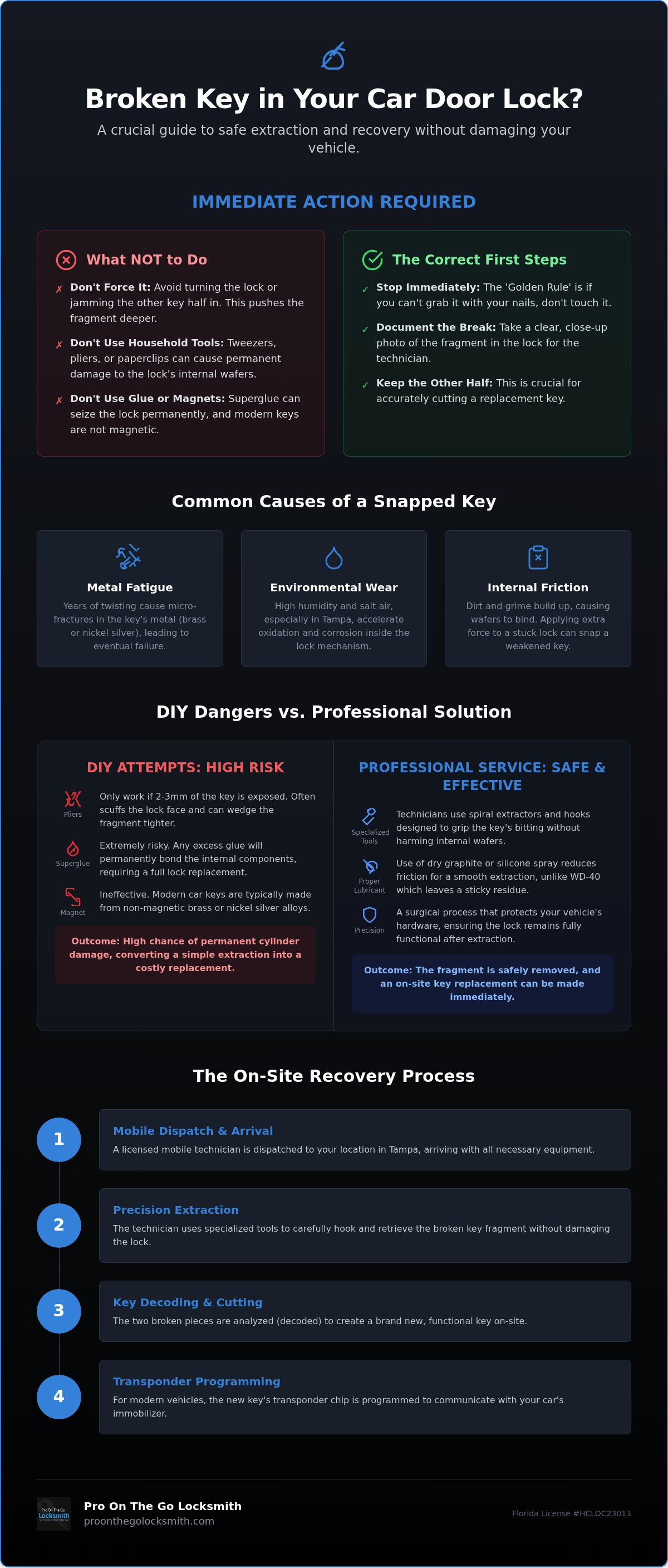
The moment you hear that metallic snap, your first instinct is likely to fix the problem yourself. Stop moving immediately. The most critical rule when dealing with a broken key in car door lock is to avoid exerting any inward pressure on the fragment. Many drivers try to "finish the turn" using a flathead screwdriver or by jamming the remaining half of the key back into the cylinder. These actions are almost always counterproductive. Instead of helping, you'll likely shove the fragment past the first few wafers, making it nearly impossible to retrieve without disassembling or drilling the lock.
Before you call for assistance, perform a quick diagnostic check of your situation. Assess the depth of the break. Is the metal fragment flush with the face of the lock, or is it recessed deep inside the keyway? If you can't see the silver or brass edge of the blade, the job has already become more complex. After checking the damage, look for an alternative entry point. Check the passenger door or the trunk. If you can gain access to the vehicle interior, you can at least escape the Florida heat while waiting for a professional to arrive.
Why Car Keys Break in the First Place
Keys don't usually snap without warning; they fail due to a combination of mechanical stress and environmental wear. Metal fatigue is the primary culprit. Most car keys are made of brass or nickel silver, which are soft enough to be cut easily but prone to micro-fractures after years of torque. In Tampa, our high humidity and salt air accelerate this process. Oxidation builds up inside the lock cylinder, creating internal friction. When the wafers bind and you apply extra force to turn the lock, the weakened metal reaches its breaking point and snaps.
The 'Golden Rule' of Broken Key Assessment
If you can't grab the fragment with your fingernails, stop touching it. Attempting to use tweezers or pliers on a recessed fragment often results in "pincer slip," which pushes the key deeper into the mechanism. Follow these steps to prepare for a successful recovery:
Document the break: Take a clear, close-up photo of the fragment inside the lock. This helps the technician determine which extraction tool is best for the specific angle of the break.
Keep the other half: Do not throw away the piece of the key still attached to your keychain. A specialist can use both pieces to decode the original bitting, allowing for an accurate car key replacement without needing the original code from the manufacturer.
Secure the area: If the fragment is sticking out slightly, don't let anyone walk past and bump it, as this could bend the metal and jam the cylinder permanently.
DIY vs. Professional Key Extraction Methods
Attempting to remove a broken key in car door lock with whatever is in your junk drawer is a gamble with high stakes. While a paperclip might seem like a viable probe, it lacks the tensile strength and specialized geometry needed to bypass the internal wafers. Professional tools are designed for microscopic clearance, whereas household items are built for general tasks. The risk profile for DIY attempts is high; one slip often converts a simple extraction into a full lock replacement. If the fragment isn't removed cleanly, the internal components can be permanently misaligned.
Before any extraction begins, lubrication is vital. Many drivers reach for WD-40, but this is a technical mistake. WD-40 is a solvent-based lubricant that leaves a sticky residue. Over time, this film attracts dust and road grime, creating a "sludge" that clogs the cylinder and causes the wafers to stick. Professionals use dry graphite or specialized silicone-based sprays. These lubricants reduce friction and help the metal fragment slide out without leaving a mess that could cause future ignition or door lock failures.
Common Household Tools: Tweezers and Pliers
Standard cosmetic tweezers are almost always too thick to enter the narrow keyway of a modern car lock. If you try to force them in, you'll likely pinch the key fragment, inadvertently pushing it deeper into the mechanism. Needle-nose pliers are only effective if at least 2-3 millimeters of the key blade are protruding from the face of the lock. If the break is flush or recessed, pliers will simply scuff the lock face without gaining a grip. In these cases, the "pinching" action of pliers can actually deform the soft brass of the key, wedging it even tighter against the lock's internal walls.
Professional Extraction Kits and Techniques
A master technician uses a suite of tools specifically engineered for the "hook and pull" maneuver. Spiral extractors are incredibly thin, serrated wires that slide alongside the fragment and "bite" into the key bitting. Once the tool hooks a tooth on the key, the technician can apply steady outward pressure to slide the piece out. For traditional edge-cut keys, sawtooth extractors provide multiple points of contact for a secure pull. In cases where the fragment is partially visible, surgical-grade hemostats offer a non-slip, locking grip that standard pliers can't match. If you find yourself staring at a snapped blade, it's often safer to request professional extraction before the situation escalates. Using the right tool ensures the cylinder remains functional for your replacement key.
The High Cost of DIY Mistakes: Why Glue and Magnets Fail
It is tempting to follow a viral video suggesting you can fish out a broken key in car door lock cylinders using a drop of superglue on a matchstick. In the field, we see the aftermath of these attempts daily. What starts as a simple mechanical retrieval often turns into a total hardware failure because of a fundamental misunderstanding of lock anatomy. These hacks ignore the precision of modern automotive security and almost always escalate the repair process. A simple extraction is a routine procedure, but a botched DIY job often forces a complete teardown of the door assembly.
Beyond glue, many drivers try to pry the fragment out with bobby pins or safety pins. This is equally dangerous. Modern locks contain delicate internal wafers that are only a few millimeters thick. When you poke around blindly with a metal pin, you risk bending these wafers or damaging the tiny springs that hold them in place. If the wafers are mangled, the cylinder will no longer recognize the bitting of a new key, even if the fragment is eventually removed. This turns a mobile service call into a complex "Total Lock Replacement" scenario, where the hardware must be ordered specifically for your vehicle's VIN.
How Glue Destroys the Cylinder Mechanism
Superglue is the most destructive substance you can introduce to a lock. Through capillary action, a single drop of liquid adhesive travels deep into the cylinder, seeping into the microscopic gaps between the wafers and the housing. Once the glue cures, it seizes the entire mechanism, bonding the moving parts into a solid, immovable block of metal. Glue is the leading cause of avoidable lock replacements because it is impossible to "clean" out of the spring chambers without destroying the seals. Applying adhesive to a lock essentially welds your problem into place permanently.
Why Magnets Won't Work on Your Key
The belief that a powerful magnet can pull a fragment out is based on a metallurgical myth. Most automotive keys are engineered from non-ferrous alloys, specifically brass or nickel silver, which are entirely non-magnetic. Even if your key contained trace amounts of iron, there are several reasons this method fails:
Minimal Surface Area: The snapped edge of a key blade provides almost no surface area for a magnet to grab.
Internal Resistance: The fragment is held in place by the friction of the spring-loaded wafers, which exert more force than any consumer-grade magnet can overcome.
Electronic Interference: Bringing high-powered neodymium magnets near modern door handles can occasionally interfere with the proximity sensors or touch-entry electronics found in newer vehicle models.
Attempting these shortcuts usually results in quintupling the final bill. While a technician can typically perform a damage-free extraction on-site, a glued or mangled lock requires the removal of the interior door panel and a full hardware swap. Protect your investment by avoiding the "quick fix" and sticking to professional mechanical solutions.
What to Expect from a Mobile Locksmith Service
When a technician arrives, they don't just bring a toolbox; they bring a specialized mobile laboratory. In Tampa, our vans are equipped with high-precision extraction rigs and computerized key-cutting stations designed for on-site recovery. The first step isn't pulling the metal; it's a methodical diagnostic assessment. We examine the cylinder to ensure the internal wafers haven't been mangled by previous force or DIY attempts. This transparency ensures you aren't paying for a new lock if the old one is still salvageable. If you're currently locked out of the cabin with the broken key in car door lock cylinders, the process often starts with a car lockout service to gain entry before we address the mechanical failure of the blade itself.
Decoding and Cutting a New Key from Scraps
Many drivers assume that once a key snaps, the original pattern is lost forever. This is a common misconception. By using specialized calipers, we measure the "depths" of the cuts on both the bow and the tip of the broken pieces. We then input these specific measurements into a computerized database to reconstruct the original key code. This is a surgical reconstruction rather than a simple duplication. Our on-site machines cut a fresh blade to OEM specifications, ensuring the new key fits perfectly without the "catch" often found in poorly cut hardware store copies. We verify the cut by testing it in both the door and the ignition to confirm smooth rotation throughout the entire cylinder path.
Key Fob and Transponder Integration
Modern car security involves more than just a metal blade. If your key has a plastic head or a remote, it likely contains a microchip. We evaluate whether your old transponder chip can be salvaged and placed into a new shell, which can often save you money on parts. However, if the chip is damaged or lost, we use diagnostic tablets to perform transponder programming, syncing the new key to your vehicle's immobilizer system. This ensures the car starts on the first turn without triggering security lockouts. For a deeper dive into the electronics behind this process, see our what is a transponder key guide.
If you're stranded in a parking lot or your own driveway, you don't need a tow truck; you need a mobile workshop that comes to you. Contact Pro On The Go Locksmith to have a new key cut and programmed right where you're parked, saving you the time and expense of a dealership visit.
Professional Extraction in Tampa: Pro On The Go Locksmith
Dealing with a broken key in car door lock assemblies requires more than just tools; it requires a technician who knows the Tampa landscape. We navigate local traffic patterns to reach you quickly, whether you're stuck at the Westshore Plaza or a residential driveway in Brandon. Our specialized mobile units are not just transport vehicles. They're fully equipped workshops capable of handling high-security and laser-cut keys commonly found in modern Florida vehicles. We prioritize transparency, which means you receive a clear explanation of the extraction process and the associated costs before the technician begins work. If your specific issue involves a snapped blade inside the steering column rather than the door, see our specialized guide on car ignition repair for a detailed look at electronic and mechanical ignition recovery.
Why Local Expertise Matters in Tampa
Our environment plays a significant role in how automotive locks fail. The combination of intense Florida heat and corrosive salt air from the Gulf leads to accelerated oxidation inside cylinder keyways. This buildup creates the exact type of internal resistance that causes metal fatigue and eventual snaps. As a localized service with Florida license #HCLOC23013, we understand these regional factors. Our technicians are trained to service both domestic and foreign security systems, from standard Ford and Chevy models to high-tech European imports. This specialized knowledge ensures that we apply the correct amount of torque and the right lubricants to preserve your hardware during the extraction.
How to Book Your Extraction Service
When you contact us, the process is streamlined to minimize your downtime. To ensure the technician arrives with the correct blanks and programming software, please have your vehicle's make, model, and year ready. Providing your specific location in the Tampa area allows us to give you an accurate arrival time based on current road conditions. Our "Modern Master Technician" approach is designed to be efficient and clean. We treat your vehicle with the same precision as a surgical procedure, focusing on damage-free extraction and immediate restoration of your access. For professional assistance and a functional key in hand, contact Pro On The Go Locksmith to start the recovery process today.
Restore Your Access and Protect Your Vehicle
A broken key in car door lock cylinders is a high-stress mechanical failure, but it doesn't have to be a permanent hardware disaster. By avoiding the common pitfalls of superglue and household probes, you prevent a routine extraction from escalating into a costly lock replacement. Professional recovery is a methodical process that prioritizes the integrity of your vehicle's security system. We use precision tools to retrieve fragments safely and employ computerized technology to decode and cut a fresh blade on the spot.
As a specialized partner in Tampa, we bring a mobile workshop directly to your location to resolve the issue without a tow truck. Our team holds Florida license #HCLOC23013 and specializes in modern transponder systems, ensuring your new key is both mechanically perfect and electronically synced. Don't let a snapped blade leave you stranded or lead to avoidable damage. You can Get Professional Key Extraction in Tampa Now and be back on the road with a functional, high-security replacement. We have a plan to get you moving again with confidence.
Frequently Asked Questions
Can a locksmith make a new key if I only have the broken pieces?
Yes, a technician can reconstruct your key code by measuring the depths of the cuts on the broken fragments. We don't just trace the pieces; we use high-precision calipers to identify the original factory specifications. This data is then fed into a computerized cutter to produce a fresh blade. Even if the key is snapped into multiple shards, we can create a functional replacement on-site as long as the bitting is visible.
Will a broken key extraction damage my car door lock?
Professional extraction is designed to be completely non-destructive. We use specialized spiral and sawtooth extractors that bypass the internal wafers to hook the key blade directly. This prevents any scratching or misalignment of the delicate spring-loaded components. However, if you've already attempted to pry the fragment out with a screwdriver or bobby pin, there may be pre-existing damage that requires a more complex cylinder repair or a total lock replacement.
How much does it usually cost to get a broken key out of a car door?
National averages for extracting a broken key in car door lock typically range between $50 and $200. Complex cases involving ignition cylinders or high-security laser-cut keys can increase these costs. In the Tampa area, mobile service fees often fall between $102 and $205 depending on the vehicle model and the depth of the fragment. Total costs will also vary if you require a transponder key replacement or fob programming during the same visit.
Can I use a magnet to pull the broken key out?
Magnets are ineffective for retrieving automotive keys because most modern blades are made of brass or nickel-silver alloys. These materials are non-ferrous, meaning they don't respond to magnetic pull. Even if your key contained steel, the friction of the lock's internal wafers is much stronger than the force of a consumer-grade magnet. Attempting this method is a waste of time and won't help you regain access to your vehicle.
Is it possible to glue the key back together just to turn the lock once?
Never use glue inside a lock cylinder. Adhesives like superglue travel through capillary action, seeping into the microscopic gaps between the internal wafers and the housing. Once the glue cures, it bonds the moving parts into a solid block, making extraction impossible. This turns a simple retrieval into an expensive hardware swap. Gluing the pieces together is the most common reason a routine service call results in a full lock replacement.
What should I do if the key broke off inside the ignition instead of the door?
If your key snaps in the ignition, the situation is more urgent because the fragment may be holding the vehicle in the "accessory" or "on" position. This can drain your battery quickly. You should avoid trying to turn the ignition with the remaining half of the key. Specialized tools are required to retrieve ignition fragments without damaging the electronic sensors or the anti-theft system integrated into modern steering columns.
How long does a professional key extraction take?
A standard extraction usually takes between 15 and 30 minutes once the technician is on-site. If the fragment is flush with the lock face, the process is very fast. However, if previous DIY attempts have shoved the metal deep into the cylinder, it may take longer to navigate the wafers safely. If you also need a car key replacement cut and programmed, you should expect the total service time to be around 45 to 60 minutes.
Does insurance cover broken key extraction or replacement?
Coverage depends on your specific policy and whether you have a roadside assistance rider. Some comprehensive plans or premium auto club memberships cover a portion of locksmith labor for extractions. You'll usually need to pay the technician upfront and then submit the itemized receipt to your provider for reimbursement. It's best to check your insurance app or call your agent to verify if key breakage is a covered peril under your current plan.


