
What to Do When Your Key Won't Turn in the Ignition: A 2026 Troubleshooting Guide

You’re sitting in a sweltering parking lot in Tampa, the humidity is rising, and you’re just trying to get home, but your key won't turn in the ignition. It’s a moment of pure frustration that quickly turns into anxiety as you wonder if you’re about to snap the blade off inside the cylinder. We understand that this isn't just a mechanical failure; it's a disruption to your safety and your schedule. You may be wondering about service costs and the next step for your vehicle.
This guide outlines common ignition symptoms, checks to discuss with a technician, and reasons to stop rather than force the key. It covers steering wheel tension, key wear and electronic systems. The cause and available service options depend on the vehicle and the condition found; this guide does not establish a diagnosis or guarantee a repair outcome, completion time or price.
Key Takeaways
Relieve steering wheel tension by applying specific pressure to the column, which often clears the path for a smooth cylinder rotation.
Compare how your main key and an available spare behave, and share the results with a technician.
Understand how environmental factors like high humidity can cause debris buildup, explaining why your key won't turn in the ignition despite no obvious damage.
Avoid pliers or excessive force, which can damage the key or ignition.
Ask a mobile locksmith whether ignition repair or re-keying is suitable for your vehicle and whether one key can operate the ignition and door locks.
Table of Contents
Immediate DIY Fixes: The First 3 Things to Check
When you find that your key won't turn in the ignition, it's often a mechanical safety feature rather than a hardware failure. Modern vehicles are designed with several interlocks that prevent the ignition from rotating unless specific conditions are met. These systems protect your car from theft and accidental rollaways, but they can occasionally become "stuck" due to physical tension or sensor misalignment. Before you assume the worst, we recommend a methodical check of the steering and transmission systems.
Unlocking the Steering Column Tension
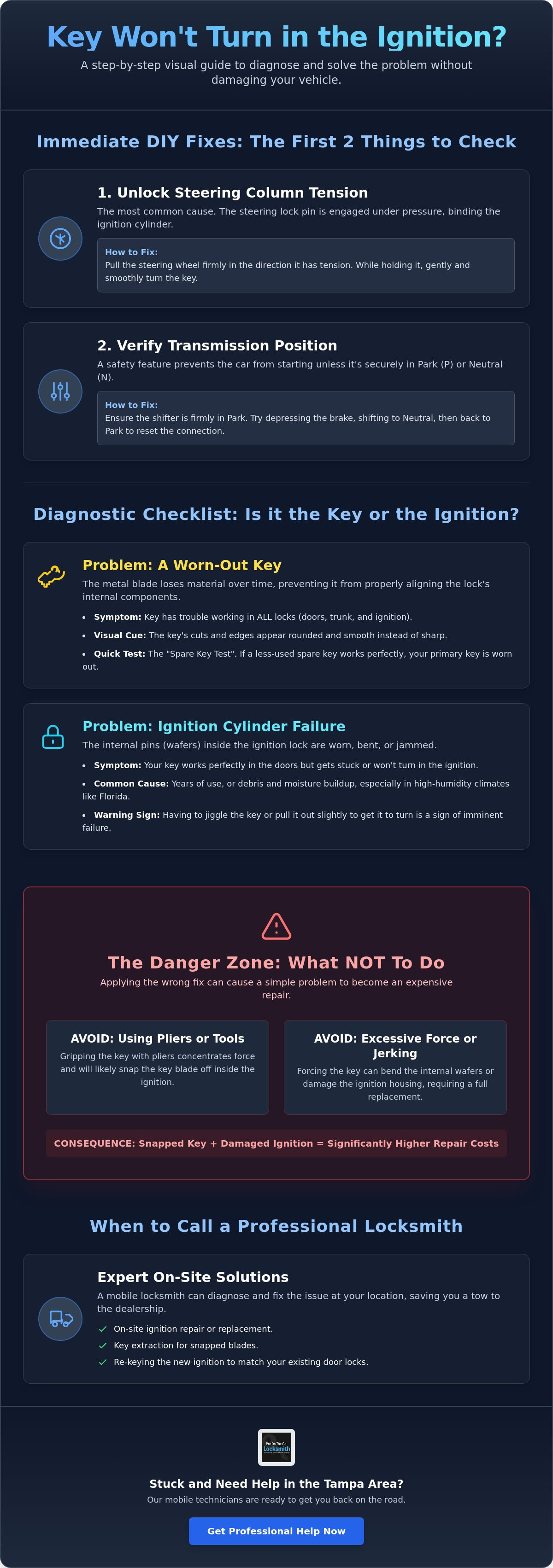
The most frequent reason a key won't turn in the ignition is a locked steering column. This happens when the steering wheel's turned after the engine is shut off, causing a spring-loaded locking pin to engage. If the wheel is resting against this pin, the resulting pressure binds the ignition cylinder. To diagnose this, visualize the internal mechanism. Understanding how an ignition switch works is helpful here; the cylinder is physically linked to the column lock. If the lock is under tension, the cylinder simply cannot move.
To resolve this, follow these steps:
Identify which direction the steering wheel feels "stuck" or has the most resistance.
Pull the wheel firmly in that direction of tension.
While holding the wheel in that position, attempt to turn the key with a smooth, firm motion.
Avoid jerking the wheel; use steady pressure to relieve the bind on the locking pin.
Following the "Gentle Pressure" rule is critical. If you force the turn while the pin's bound, you risk deforming the internal components or snapping the key blade. If the key still won't budge, the problem might not be the steering column at all.
Verifying the Transmission Position
Another common "trap" involves the gear shifter. Automatic transmissions utilize a neutral safety switch or a shift-interlock solenoid to ensure the vehicle only starts in Park or Neutral. Over time, these components can wear down or collect debris. If the shifter's even a millimeter out of position, the ignition's internal lock will remain engaged. It's a common issue in older vehicles where the linkage has become loose.
Start by verifying that the shifter is firmly seated in Park. If it looks correct but the key remains stuck, try the "Jiggle and Shift" technique. Depress the brake pedal, move the shifter into Neutral, and then firmly click it back into Park. This movement often resets the physical connection to the ignition housing. If your vehicle allows it, try turning the key while the shifter is in Neutral. This test helps isolate whether the problem lies with the shifter assembly or the ignition cylinder itself. If these mechanical resets don't solve the problem, the issue likely involves internal wear or debris.
Diagnostic Checklist: Is the Problem the Key or the Cylinder?
If the mechanical resets for your steering wheel and shifter didn't work, you must determine whether the failure is in the key or the ignition cylinder itself. This distinction is vital because it dictates whether you need a new key or a full ignition rebuild. You can start by cross-referencing your symptoms; if your key works perfectly in the door locks but the key won't turn in the ignition, the ignition cylinder's internal wafers are likely the culprit. Conversely, if the key is difficult to use in every lock on the vehicle, the metal blade has likely reached the end of its service life.
A difference between your main key and a spare is useful information to discuss with a technician, but it does not establish a diagnosis by itself. If you do not have a spare, note visible wear or damage on the key and describe any resistance you notice. Avoid forcing either key.
Signs of a Worn-Out Mechanical Key
Key bitting refers to the unique series of cuts and depths on a key blade that correspond to the internal pins or wafers of a lock. Even a minuscule loss of material, as little as 0.01 inches of wear, can prevent these wafers from reaching the necessary shear line to allow rotation. You might find that flipping the key to "Side-B" or pulling it out slightly before turning works temporarily. This is a major warning sign that the bitting is no longer making proper contact. Relying on these tricks is a gamble that often ends with a snapped blade.
Identifying Ignition Lock Cylinder Failure
Ignition cylinders are high-use mechanical components that eventually fail after thousands of cycles. Before a total seizure, you'll often notice a "sticky" or "crunchy" sensation when inserting the key. This indicates that the internal wafers are bent or the return springs have weakened. For a temporary fix, the "Tapping Method" can be effective. While holding the key in the ignition, lightly tap the head of the key with a screwdriver handle. The vibration can sometimes vibrate a stuck wafer back into position just long enough to get the car started.
Modern high-security "sidewinder" keys, which feature a track cut into the face rather than the edge, fail differently than traditional blades. They are less prone to bending but more sensitive to debris buildup within the track. If your diagnostic tests point toward a deeper mechanical failure, contacting a specialist for ignition repair can help you discuss the symptoms and whether an inspection is appropriate.
Advanced Troubleshooting: Debris, Electronics, and Florida Weather
Beyond mechanical wear, external environmental factors often dictate why a key won't turn in the ignition. For drivers in coastal environments like Tampa, the combination of high humidity and salt air creates a unique set of challenges. Salt air accelerates internal corrosion, leading to oxidation on the delicate brass wafers. This process often turns factory lubricants into a thick, sticky paste that prevents the wafers from moving freely. If your ignition feels sluggish or requires multiple attempts to rotate, you are likely dealing with this specific "gumming" effect.
Physical obstructions are another common culprit. Every time you slide your key into the cylinder, it carries microscopic amounts of pocket lint, dirt, and metal shavings. Over thousands of cycles, this debris compacts at the back of the keyway. This prevents the key from seating fully, which in turn stops the wafers from aligning with the shear line. A professional YourMechanic inspection service can often confirm if the blockage is deep within the housing or if it’s an electronic failure related to the vehicle's security system.
Cleaning and Lubricating the Ignition Safely
Restoring a stuck cylinder requires a precise touch. We strictly follow the "Dry Lube" Rule. Never use oil-based products like WD-40 or heavy grease; these attract dust and will eventually seize the lock entirely. Instead, use a dry film lubricant like graphite or PTFE. Before applying any lubricant, use a can of compressed air to blow out the keyway. This removes loose particles rather than pushing them deeper. Apply a small burst of dry lube to the key blade itself, slide it in and out several times, and then attempt a gentle turn. This method protects the sensitive electronic sensors located near the ignition housing.
Battery and Immobilizer Issues
Modern vehicle security adds a digital layer to the mechanical turn. If your car battery is completely flat, the electronic shift-interlock or steering lock may not receive the signal to release. This is especially common in 2026 models with advanced encryption. The vehicle must verify the transponder signal before the mechanical lock allows rotation. To understand the complexity of this system, you can read our guide on what is a transponder key. If you see a security light flashing or a car key not detected error on your dashboard, the physical ignition might be fine while the electronic handshake is failing. Check your battery voltage first; a jump-start often resolves a "stuck" ignition key in electronically-governed systems.
The Danger Zone: What NOT to Do with a Stuck Key
When your key won't turn in the ignition, the rising heat and mounting stress can tempt you to use excessive force. We often see the results of "quick fixes" found on community forums that end in catastrophic failure. Brute force is never a substitute for precision alignment. If the internal wafers are bound, applying torque with a tool will only result in structural damage to the lock housing or the key itself. Precision hardware requires a methodical touch, not a heavy hand.
The Physics of a Snapped Key
Most automotive keys are made of brass or nickel-silver. Manufacturers choose these materials for their ability to be cut with precision, not for high shear strength. In contrast, the ignition housing is often made of hardened steel or zinc alloy. When you apply leverage with pliers, the brass blade cannot withstand the torque and shears off. This frequently results in a car key snapped in ignition, usually flush with the cylinder face. Extracting a broken key is a high-precision task that involves manipulating individual wafers to release the trapped metal without scarring the internal tracks.
Avoiding Chemical Damage
Many drivers reach for WD-40 or similar penetrating oils as a first response. While this might provide a temporary "slickness," these oils attract dust and pocket lint. Inside the tight tolerances of an ignition, this mixture creates a thick grinding paste that accelerates wear on the pins over time. Modern vehicles also feature a transponder antenna ring located directly around the keyway. Flooding this area with generic chemicals can short out these sensitive electronics. This leads to a situation where the vehicle won't recognize even a perfectly cut key, complicating the diagnostic process.
If troubleshooting has not resolved the problem, stop rather than applying more force. If the steering wheel is unlocked and the shifter is in Park, but the key won't turn in the ignition after a few gentle attempts, stop. Forcing it can damage the key or ignition. Ask a technician about an inspection and whether professional Broken Car Key Extraction or ignition repair is appropriate for the condition found.
Professional Solutions: Ignition Repair vs. Key Replacement
When a key won't turn in the ignition, ask about the available service options before arranging a repair. Whether work can be completed on-site, whether the cylinder can be matched to existing door keys, and whether towing is needed depends on the vehicle and the fault. Confirm these details with the technician.
Before choosing mobile car key replacement or repair, ask what inspection is needed, which parts may require work, and what the quoted price includes. Confirm any programming requirements and how the completed work will be checked.
When to Call Pro On The Go Locksmith
Stop if the key resists turning instead of relying on a fixed troubleshooting time limit. Contact Pro On The Go Locksmith with the vehicle's year, make, model and symptoms. If the key won't turn in the ignition, ask about inspection, repair options and availability before arranging service.
What to Expect During a Mobile Ignition Repair
An inspection is needed before the available repair options can be confirmed. Describe the symptoms and provide the vehicle's year, make and model when requesting service. Ask whether Car Key Replacement is appropriate, whether transponder programming is required, and what equipment or parts the job needs. Confirm the expected timing, estimate and testing process with the technician before work begins.
Restoring Your Vehicle's Reliability
Dealing with a situation where your key won't turn in the ignition is a diagnostic puzzle that requires a calm, methodical approach. We have explored how simple steering column tension or gear shifter misalignments can be resolved with a few precise movements. You now understand the risks of using brute force and why maintaining the integrity of your ignition housing is vital for your vehicle's long-term value. Precision and patience are your best tools during this high-stress moment.
If the initial checks do not resolve the problem, stop rather than force the key. Need help in Tampa? Contact Pro On The Go Locksmith about mobile ignition service. Share your location and vehicle details to confirm service availability and discuss the next step. Ask about the scope, estimated cost and timing of an inspection before arranging work.
Frequently Asked Questions
Can a dead battery cause the key not to turn in the ignition?
Yes, a dead battery can absolutely prevent the key from rotating in many modern vehicles. When the battery lacks sufficient voltage, the electronic shift-interlock or steering column solenoid fails to release. This mechanical lock stays engaged as a safety precaution. If your key won't turn in the ignition and the dashboard lights are dim or non-responsive, try a jump-start to reset the electronic release.
Is it safe to use WD-40 in my car's ignition cylinder?
You should avoid using WD-40 or any oil-based lubricant in your ignition cylinder. These products are "wet" and attract pocket lint, dust, and metal shavings, which eventually form a thick sludge. This mixture will gum up the delicate internal wafers and cause a total seizure. Instead, use a dry-film lubricant like graphite or PTFE to ensure the internal components move freely without attracting debris.
How much does it typically cost to fix a key that won't turn?
The total cost to resolve an ignition issue depends on whether the problem is the key, the cylinder, or a security sensor. Factors such as your vehicle's make, the complexity of the transponder programming, and the extent of the mechanical wear will influence the final price. Request an estimate for your vehicle and symptoms, and confirm whether on-site work is suitable and whether towing or other charges could apply.
Why does my key turn in the door but not the ignition?
This symptom usually points to internal wear within the ignition cylinder rather than a problem with the key blade. Ignition locks undergo significantly more mechanical stress and cycles than door locks, leading to bent wafers or weakened return springs. If the key works in the door, the bitting is likely correct, but the ignition's internal tolerances have drifted too far to allow a successful turn.
Can a locksmith fix an ignition on-site, or do I need a tow?
On-site service may be an option, but it cannot be confirmed from this symptom alone. Provide the vehicle's year, make, model, location and symptoms when requesting help. Ask whether the work can be completed at that location, what timing and charges to expect, and whether towing may be needed.
What happens if my key snaps off while I'm trying to turn it?
If your key snaps, stop immediately and do not attempt to glue the pieces back together or fish the fragment out with tweezers. A technician can assess the broken key and explain the available extraction options. If the key won't turn in the ignition because of a partial break, describe the break when requesting service and ask whether extraction or a replacement key can be handled at your location.
Why is my steering wheel locked and the key won't budge?
Your steering wheel is likely resting against the internal locking pin, which creates physical tension on the ignition lock. This is a common anti-theft feature that engages if the wheel is moved while the car is off. To fix this, pull the steering wheel firmly in the direction that has the most give. While holding it there, turn the key with a steady, gentle motion to release the bind.
Does a worn-out key fob battery affect the physical turning of the key?
In most traditional vehicles, a dead fob battery only affects the remote entry and won't stop the physical key from turning. However, some 2026 models with advanced immobilizer systems require an active electronic handshake before the mechanical cylinder will unlock. If your car uses a "turn-key" style but has smart features, a dead fob battery might trigger a security lockout that prevents the physical rotation of the key.


