
Transponder Key Programming Cost: 2026 Price Guide & Expert Insights

Updated: 7 days ago
The dealership wants hundreds of dollars, they need your car towed in, and suddenly a lost transponder key has turned into a half-day ordeal with a bill that feels completely disconnected from the size of the problem. Sound familiar? You're not alone, and your frustration is completely justified.
Here's the truth about transponder key programming cost that most dealerships won't volunteer: a significant portion of what you're paying for isn't the key itself. It's software licensing, proprietary diagnostic access, and the overhead of a service bay that was never designed with your convenience in mind. The piece of plastic is almost incidental.
This guide cuts through the confusion. Whether you've been trying to decode the difference between a chip key and a key fob, or you're staring down a tow truck quote just to get your car to a dealer, you'll find clear answers here. We'll break down the real technical factors that drive programming costs, explain what separates a qualified mobile locksmith from a scam operation, and show Tampa drivers exactly how to get this handled without the unnecessary markup or the tow bill.
Table of Contents
What Is Transponder Key Programming and Why Does It Have a Cost?
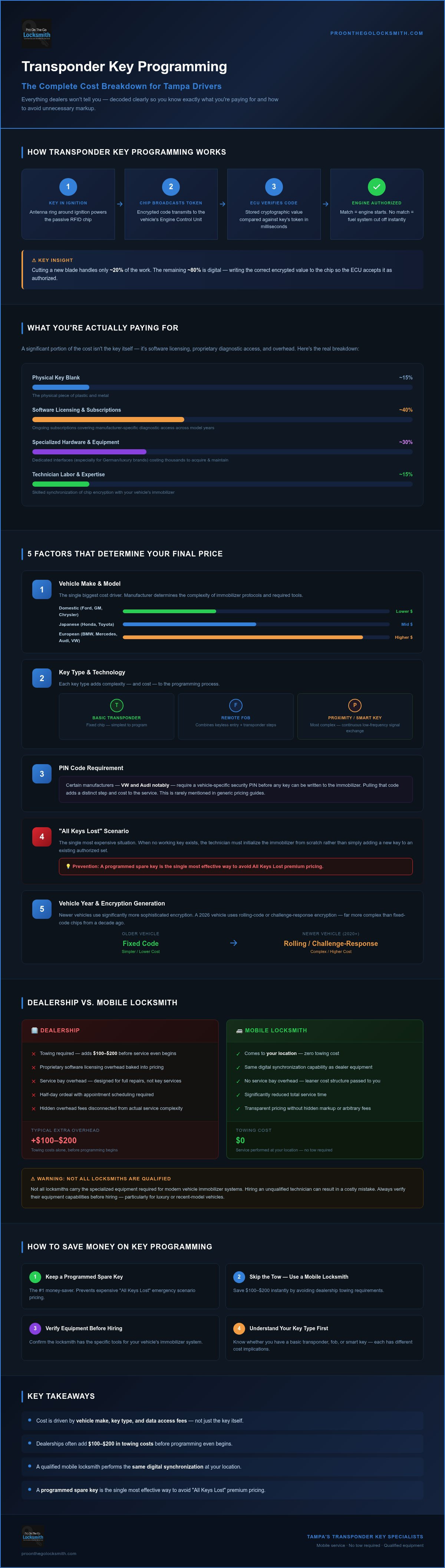
Strip away the jargon and transponder key programming is, at its core, a digital handshake. A technician synchronizes the encrypted code stored inside your key's chip with the unique identifier registered in your vehicle's immobilizer system. When those two values match, the car starts. When they don't, the engine is cut off at the fuel system level, regardless of whether the ignition turns freely. That single security mechanism is why a freshly cut key blank does nothing without programming, and it's the primary reason a real cost is attached to the service.
Understanding transponder car key technology helps clarify why this isn't a simple duplication job. The chip embedded in your key head is a passive RFID device, meaning it carries no battery of its own. Instead, it draws energy from the antenna ring surrounding your ignition cylinder, uses that energy to broadcast its encrypted token, and the ECU either grants or denies engine authorization in milliseconds. The whole exchange happens before you hear the engine turn over.
The Role of the Vehicle Immobilizer
Your vehicle's Engine Control Unit acts as the gatekeeper. It holds a stored cryptographic value and compares it against the token broadcast by the key on every single start attempt. Cutting a new key blade handles the mechanical side of the job, but that accounts for roughly 20% of the total work. The remaining 80% is digital: writing the correct encrypted value to the chip so the ECU accepts it as authorized. Skip that step, and you have a key that fits the lock but can't start the car.
Software vs. Hardware: The Invisible Costs
This is where transponder key programming cost gets more layered than most people expect. The physical key blank is relatively inexpensive. What drives the price upward is the software infrastructure required to communicate with your specific vehicle's immobilizer protocol. Licensing for professional-grade programming platforms isn't a one-time purchase; it's an ongoing subscription that covers manufacturer-specific diagnostic access across model years. German brands and luxury vehicles often require dedicated hardware interfaces that cost thousands of dollars to acquire and maintain, with annual update fees to ensure compatibility with current model encryption standards. A technician working on a 2026 vehicle is dealing with significantly more sophisticated rolling-code or challenge-response encryption than what existed in fixed-code chips from a decade ago. That complexity is real, and it's reflected in what qualified professionals charge.
Factors That Determine Your Transponder Key Programming Cost
Not every transponder job is created equal, and the price difference between programming a key for a 2015 Honda Civic versus a 2024 BMW 5 Series isn't arbitrary. Several distinct variables stack on top of each other to produce the final number, and understanding each one gives you a realistic baseline before you call anyone.
Vehicle make and model is the most immediate cost driver. Domestic brands like Ford, GM, and Chrysler generally use more accessible immobilizer protocols with widely available programming support. European manufacturers, particularly BMW, Mercedes-Benz, Audi, and Volkswagen, operate on proprietary communication architectures that require dedicated hardware interfaces and brand-specific software licenses. Luxury vehicles from any region tend to fall into a higher pricing tier for the same reason. The car's security system is simply more complex to communicate with, and that complexity costs money to service properly.
Key type creates another pricing layer entirely. A basic transponder key with a fixed chip is the most straightforward to program. An integrated remote fob, which combines keyless entry with the transponder function, involves additional synchronization steps. Proximity or "smart" keys, the kind that start the car while staying in your pocket, represent the most labor-intensive category. They communicate through a continuous low-frequency signal exchange rather than a single ignition event, and the programming process reflects that added complexity.
One factor that rarely gets mentioned in generic pricing guides is the PIN code requirement. Certain manufacturers, Volkswagen and Audi being prominent examples, require a vehicle-specific security PIN before any key can be written to the immobilizer. Pulling that code through legitimate channels involves accessing a manufacturer database, and some of those lookups carry their own per-transaction fee. That cost gets passed through to the customer, and it should. It's a legitimate security layer, one that exists precisely because vehicle theft prevention standards have pushed manufacturers toward layered authentication systems that are harder to bypass without authorization.
Geographic labor rates also matter. Tampa Bay sits in a mid-range position nationally for automotive service labor. You're not paying the premium rates common in major metro markets like New York or Los Angeles, but you're above rural pricing floors. A mobile locksmith operating in Tampa eliminates the tow requirement that dealerships almost universally impose, which is where local pricing context works in your favor.
The Complexity of the Encryption
Older fixed-code chips broadcast a static value every time. Newer systems use rolling codes or challenge-response protocols, where the key and ECU generate a new synchronized value on each start cycle. Programming these systems takes longer and requires software capable of tracking the current synchronization state. Brands like BMW and Mercedes add proprietary gateway modules that restrict third-party tool access entirely on recent model years, effectively requiring certified equipment just to open a communication channel. That's a real equipment investment, not a markup.
Availability of Security Data
Counterintuitively, older vehicles can sometimes cost more to program than mid-generation models. If a manufacturer's database records for a specific year are incomplete or the vehicle predates standardized OBD-II immobilizer protocols, a technician may need to use alternative decoding methods that add labor time. On the other end, using an aftermarket key blank instead of an OEM-equivalent part can introduce compatibility issues with newer encrypted systems, potentially requiring additional verification steps. OEM-grade keys cost more upfront, but they reduce the risk of a failed write and a second service call.
If you're trying to make sense of where your specific vehicle falls in this pricing spectrum, a quick consultation with a qualified mobile locksmith like Pro On The Go Locksmith can give you a vehicle-specific estimate before any work begins.
Dealership vs. Mobile Locksmith: A Cost and Convenience Breakdown
The dealership isn't your only option. It's just the most visible one. And visibility, in this case, comes with a price premium that has very little to do with the quality of the programming work itself.
Dealership service departments carry significant fixed overhead: facility costs, tiered labor rates, service advisor commissions, and diagnostic billing structures that were designed around warranty repair work, not single-key programming jobs. When you bring a transponder key programming cost into that environment, you're absorbing a share of all that infrastructure whether you benefit from it or not. That's the dealership tax. It's not a conspiracy; it's just how their business model distributes costs across every ticket that comes through the service bay.
Then there's the tow requirement. If your car won't start because you've lost your only key, most dealerships won't program a replacement at your location. They need the vehicle on-site. That means a tow truck, which adds a real, separate expense before any actual key work begins. A mobile locksmith eliminates both problems at once: no tow, no service bay overhead, and no half-day appointment window to work around.
Time is the other variable that rarely appears in a price comparison. Dealership scheduling runs on their capacity, not yours. A mobile technician comes to your location and, for most standard transponder programming jobs, completes the work in under an hour. The vehicle stays where it is. You stay where you are.
Duplicate Keys vs. All Keys Lost
This is the pricing gap that most generic guides skip entirely. Duplicating a working transponder key is a straightforward process: the technician reads the existing key's data and writes a matching encrypted value to the new chip. The immobilizer system already has a registered token to reference, which simplifies the entire procedure.
An "All Keys Lost" scenario is a fundamentally different job. With no working key present, the technician can't read an existing chip. Instead, they must access the vehicle's immobilizer module directly, delete all previously registered keys from the system's memory, and re-flash the module to accept newly programmed keys from scratch. That process is more labor-intensive, requires deeper software access, and on some makes involves the PIN retrieval step covered earlier. The result is a higher service cost, which is entirely justified by the technical scope of the work involved. For a detailed breakdown of what that process looks like in practice, the Mobile Car Key Replacement 2026: The Complete Professional Guide walks through each stage clearly.
Quality and Warranty Considerations
A persistent myth positions mobile locksmiths as a cut-rate alternative using inferior hardware. In practice, qualified automotive locksmiths source OEM-equivalent transponder chips that meet the same encryption and frequency specifications as dealer-supplied keys. The chip quality isn't the differentiator. The technician's equipment and training are.
On the warranty side, a local mobile provider like Pro On The Go Locksmith, licensed under Florida license #HCLOC23013, can address a service issue quickly because there's no corporate escalation process between you and the technician who did the work. Compare that to resolving a warranty concern through a dealership service center, where the advisor, technician, and parts department all operate as separate layers. Local accountability moves faster. That's a practical advantage, not just a marketing claim.
How to Save Money on Car Key Transponder Programming
The most effective cost-reduction strategy has nothing to do with negotiating or shopping around. It's preventative: get a spare key programmed before you ever need one. A duplicate transponder key programmed while you still have a working original is a straightforward, lower-cost job. Lose that original entirely, and you're looking at an "All Keys Lost" procedure that costs significantly more because the technician has to work from scratch at the immobilizer level. That price gap is real, and a spare key eliminates it entirely.
One spare key is not an indulgence. It's the single highest-return investment you can make in your vehicle's operating continuity.
Buying Your Own Blank Key: Proceed Carefully
Sourcing your own transponder blank online before calling a technician can reduce material costs, but it carries a genuine risk. Not every aftermarket chip is compatible with every immobilizer protocol, and a mismatched blank can result in a failed write that requires a second service call. If the blank you've purchased won't accept the correct encrypted value, you've paid for a part you can't use and still need a new one. Only buy your own blank if a qualified technician has confirmed the exact chip specification your vehicle requires beforehand.
Bundle Services While the Technician Is On-Site
A mobile locksmith's travel time is a fixed cost. Once they're at your location, adding a second service doesn't duplicate that overhead. If your ignition has felt stiff, or you've been considering a residential lock rekey, scheduling those alongside your transponder key programming appointment is a straightforward way to get more value from a single dispatch. The transponder key programming cost stays the same; you're simply making the trip count for more.
Verify the Technician Before You Commit
Bait-and-switch pricing is a real problem in the locksmith industry. A quote that sounds unusually low over the phone can inflate sharply once a technician is on-site, citing vague "complexity fees" or undisclosed equipment charges. Protect yourself with three specific steps before booking:
Ask for a flat-rate quote by VIN. Your Vehicle Identification Number tells a qualified technician exactly what equipment and software your car requires. A flat-rate quote based on your VIN leaves no room for on-site surprises.
Confirm mobile service availability. This eliminates the tow cost entirely, which is where Tampa drivers recover real money on this service.
Check for a valid Florida license. A licensed provider like Pro On The Go Locksmith, operating under Florida license #HCLOC23013, has verifiable accountability that unlicensed operators simply don't.
The Risks of DIY Programming Kits
Cheap OBD-II programmers marketed online promise significant savings on transponder key programming cost, but the failure mode is severe. These tools communicate directly with your vehicle's ECU, and an interrupted write, an incompatible protocol, or a firmware mismatch can corrupt the immobilizer module entirely. A corrupted ECU isn't a failed key job; it's a bricked computer that may require module replacement or dealer-level reflashing to recover. That repair bill dwarfs what a qualified technician would have charged from the start.
If your key is already behaving erratically before you've attempted any programming, the issue may be a detection fault rather than a programming failure. The guide on Car Key Not Detected? A Guide to Troubleshooting and Car Ignition Repair covers those diagnostic steps clearly before any programming work begins.
The math is straightforward: professional programming is a defined, predictable cost. ECU recovery is not. Don't let a discount tool turn a manageable expense into a major repair.
Why Pro On The Go Locksmith is Tampa’s Choice for Transponder Service
Choosing a partner for automotive security requires more than just a search for the lowest price. It requires a technician who understands the digital architecture of your vehicle. Pro On The Go Locksmith has established itself as a specialized leader in the Tampa Bay area by focusing on technical precision and local accountability. We operate under Florida license #HCLOC23013, providing a level of verified professional standing that unlicensed mobile operators cannot match. When you are evaluating the total transponder key programming cost, you are investing in the technical caliber of the technician and the reliability of the final synchronization.
Our technical focus remains fixed on the future. As we move through 2026, vehicle encryption protocols continue to grow more complex, requiring sophisticated diagnostic interfaces and constant software updates. We don't just cut keys. We manage the secure data exchange required to satisfy modern immobilizer systems. Our goal is to provide a competitive transponder key programming cost while maintaining dealership-level security standards for every client we serve.
Transparency serves as the foundation of our service model. We provide flat-rate quotes based on your specific VIN, ensuring that the number you hear over the phone is the number you pay on-site. There are no hidden "emergency fees" or unexpected surcharges for high-security models. We believe that professional service should be predictable, especially during the high-stress scenario of a lost or broken key.
Our Advanced Programming Equipment
Modern vehicle security is a software-driven field. We utilize the latest diagnostic tools designed to communicate safely with your car's Engine Control Unit without the risk of data corruption or "bricking" the module. Our equipment supports a vast range of makes and models, including high-security European brands and the latest proximity smart keys. If you find yourself locked out while waiting for a replacement, our Professional Car Lockout Service: Vehicle Recovery Guide ensures you regain access to your cabin safely before the programming begins.
The Convenience of On-Site Solutions
Efficiency is our primary deliverable. We eliminate the need for a tow truck and the frustration of a dealership waiting room by bringing the entire service bay to your driveway or office parking lot. Our mobile units are fully equipped to handle the entire lifecycle of the job in a single visit. We perform the extraction of broken blades, the precision mechanical cutting of the new key, and the final digital programming on the spot. Most jobs are completed in under an hour, allowing you to resume your day without the logistical nightmare of a multi-day dealership service ticket.
Need a spare or lost your only key? Contact Pro On The Go Locksmith for a quote in Tampa!
Secure Your Vehicle Access with Technical Precision
Modern vehicle security is an evolving landscape. You've seen how the digital handshake between your key and the ECU is the real driver of value. By choosing a mobile specialist over a dealership, you bypass the towing trap and high service bay overhead while receiving the same high-tier encryption support. This approach ensures you aren't paying for dealership real estate, but rather for the technical skill required to sync your car's immobilizer correctly. Prevention remains your best financial strategy; a spare key today prevents a major emergency expense tomorrow.
Managing your transponder key programming cost shouldn't involve hidden fees or multi-day waits. Pro On The Go Locksmith brings specialized 2026 security expertise directly to your driveway. As a licensed Florida locksmith, license #HCLOC23013, we provide the transparent results you need to get back on the road. Don't let a missing key disrupt your week or lead to an expensive tow bill. Whether you're in downtown Tampa or the surrounding suburbs, our mobile service restores your access with precision and speed.
Ready to secure a backup or solve an all keys lost emergency? Get a Transponder Programming Quote in Tampa from a technician who understands your car's digital requirements. We're ready to help you move forward with confidence.
Frequently Asked Questions About Transponder Key Programming Cost
How much does it cost to program a transponder key in 2026?
Transponder key programming cost varies based on your vehicle's make, model, and key type, so there's no single universal figure. Domestic vehicles with standard chip keys sit at the lower end of the pricing spectrum, while European luxury brands and proximity smart keys occupy a higher tier due to proprietary software requirements and encryption complexity. The most accurate approach is to provide your VIN to a qualified technician for a flat-rate quote specific to your vehicle.
Keep in mind that an "All Keys Lost" scenario carries a meaningfully higher cost than a straightforward duplicate, because the technician must access and re-flash the immobilizer module rather than reading an existing key. That distinction alone can be the largest variable in your final bill.
Can I program a transponder key myself without a pro?
Consumer-grade OBD-II programming kits are available online, but the risk profile is severe. A failed or interrupted write can corrupt your vehicle's immobilizer module entirely, turning a manageable key job into a module replacement or dealer-level ECU reflash. That repair cost significantly exceeds what a qualified technician would have charged from the start.
Some older vehicles support a basic self-programming procedure through a timed ignition sequence, but this only works when at least one working key is already present. For any modern vehicle with rolling-code or challenge-response encryption, professional equipment isn't optional; it's the only safe path to a reliable result.
Does a mobile locksmith charge more than a dealership for programming?
In most cases, a qualified mobile locksmith's total cost is lower than a dealership's, not higher. Dealership service departments carry significant fixed overhead that gets distributed across every service ticket, and they almost universally require the vehicle to be towed in if no working key exists. That tow adds a real, separate expense before any programming work begins. A mobile technician eliminates both the tow cost and the service bay markup.
The key distinction is "qualified." A licensed mobile locksmith using professional-grade diagnostic equipment delivers the same immobilizer synchronization quality as a dealership. Verify the technician's licensing status and ask for a VIN-based flat-rate quote before committing to anyone.
What information do I need to provide to get a transponder key programmed?
Your Vehicle Identification Number is the single most important piece of information. A qualified technician uses the VIN to identify your exact immobilizer protocol, confirm the correct chip specification, and determine whether a security PIN retrieval is required before programming can begin. With a VIN in hand, a professional can provide an accurate flat-rate quote before any work starts.
You'll also need to provide proof of vehicle ownership, typically a title or registration, along with a valid photo ID. This is a standard security requirement that protects you as much as it protects the technician. Reputable providers won't skip this step, and you shouldn't want them to.
How long does the transponder key programming process take?
For a standard duplicate transponder key where a working original is present, most jobs are completed in under an hour on-site. The technician reads the existing chip data, cuts the new blade to specification, writes the encrypted value to the new chip, and verifies the start cycle. It's a focused, sequential process with no waiting room involved when a mobile technician comes to your location.
An "All Keys Lost" procedure takes longer because the technician must access the immobilizer module directly, clear all previously registered keys, and re-flash the system before writing new keys. Complex European makes with proprietary gateway restrictions add additional steps. Expect a realistic estimate of one to two hours for those scenarios, depending on the vehicle.
Will programming a new key delete my old lost keys from the system?
It depends entirely on the procedure used. A standard duplicate key programming adds a new authorized key to the immobilizer's memory without removing existing entries. If your lost key is found by someone else, it would still start the car. That's a genuine security concern worth discussing with your technician upfront.
An "All Keys Lost" procedure, by contrast, wipes all previously registered keys from the immobilizer and re-registers only the new keys being programmed. If you want to definitively revoke a lost key's access, that full re-flash process is the appropriate solution. It costs more, but it restores the integrity of your vehicle's security system completely.
Why does my car need a transponder key if it has a physical blade?
The physical blade handles only the mechanical side of starting your car: turning the ignition cylinder. The transponder chip embedded in the key head handles the digital side: authorizing the Engine Control Unit to allow fuel delivery and engine startup. Both functions must succeed simultaneously. A correctly cut blade with an unprogrammed or mismatched chip will turn the ignition freely but the engine won't start because the ECU has blocked it at the fuel system level.
This two-layer system exists because mechanical key duplication alone became too easy to exploit. Transponder authentication added a cryptographic barrier that a copied blade can't bypass, which is why modern vehicle theft prevention standards pushed manufacturers toward requiring it across virtually all production vehicles.
Can you program a key if I bought it online from a third party?
Sometimes, but with important caveats. A technician can attempt to program a third-party key blank, but compatibility can vary. Aftermarket chips vary in quality and may not support the specific encryption protocol your immobilizer requires. A mismatched blank can result in a failed write, leaving you with an unusable part and still needing a compatible key sourced separately.
The safest approach is to confirm the exact chip specification with a qualified technician before purchasing anything online. If the blank you've already bought is confirmed compatible, programming it is straightforward. If it's not, the cost of a second service call and a replacement blank will exceed what an OEM-equivalent key would have cost from the start. When in doubt, let the technician source the correct blank directly.
For vehicle-specific service, explore transponder key programming in Tampa.


