
Symptoms of a Bad Transponder Key: Is Your Chip Key Failing?
- Pro On The Go Locksmith
- 4 days ago
- 12 min read

That expensive engine repair you're dreading might actually be a simple digital failure hiding in your pocket. It's a frustrating reality for many drivers in Tampa: you turn the key, the engine refuses to crank, and your first instinct is to call a tow truck for a mechanic. We understand that feeling of being stranded, especially when you're caught between the confusion of a mechanical breakdown and an electronic glitch. However, before you pay for a costly tow to a dealership, it's vital to determine if the security system is the real culprit.
Recognizing the specific symptoms of a bad transponder key can save you hundreds of dollars in unnecessary repairs. In this guide, we'll provide a methodical breakdown of how to identify a failing chip versus a simple dead battery. We'll also examine how the intense heat and humidity in Florida can corrode internal circuits and cause these systems to desync. By the end of this article, you'll know exactly how to verify if your key is the problem and how a mobile technician can restore your access right where you're parked.
Table of Contents
Recognizing the Primary Symptoms of a Bad Transponder Key
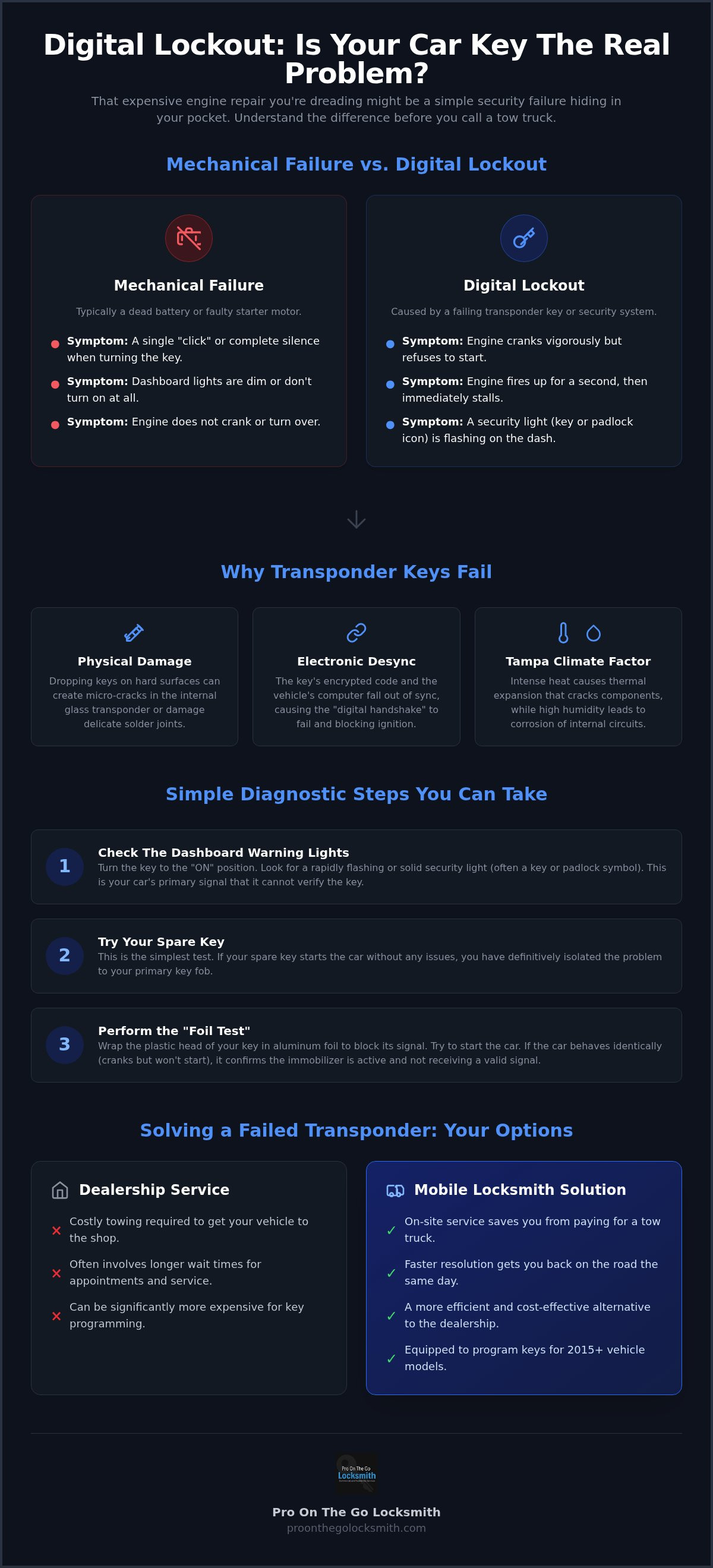
Identifying a failure begins with careful observation. Most drivers assume a "no-start" condition points to a dead battery or a faulty starter motor. However, the symptoms of a bad transponder key are distinct because they involve the vehicle's anti-theft logic rather than mechanical wear. If your car cranks vigorously but refuses to "catch" or stay running, the engine control unit (ECU) is likely blocking the ignition process. It's a digital wall, not a mechanical break.
Watch for these specific indicators during your next start attempt:
The engine fires for a brief second and then immediately stalls.
The ignition cylinder turns freely, but the dashboard remains dark and unresponsive.
The car starts intermittently, requiring three or four attempts before the handshake succeeds.
The central locking system fails to respond to button presses, even after a battery swap.
A car key not detected message on your dashboard is the most direct evidence of a failing chip or a damaged antenna ring. When this happens, the vehicle is essentially protecting itself from what it perceives as an unauthorized entry attempt.
The Engine Immobilizer Trap
The immobilizer acts as a digital gatekeeper. When you insert your key, the car sends a wireless pulse to the transponder chip. If the chip is damaged, the ECU cuts the fuel supply or the spark. This creates a specific failure pattern where the engine sounds healthy while cranking but never fully ignites. Unlike a dead starter motor, which produces a single click or total silence, an immobilizer lockout allows the mechanical components to move while disabling the combustion process. It's a calculated shutdown designed to prevent theft.
Dashboard Warning Lights and Error Messages
Modern vehicles communicate security status through specific iconography. Look for a padlock symbol, a key-shaped icon, or a small red light on top of the dashboard. A rapidly flashing security light typically indicates that the car recognizes a key is present but cannot verify its unique digital signature. If the light stays solid for more than five seconds after you turn the ignition, the system has likely entered a lockout mode. High-tech infotainment screens in 2026 models often provide more detailed text alerts, explicitly stating "Security Authentication Failed" or "Key Programming Required." These signals are the car's way of telling you the hardware is fine, but the credentials have expired.
Mechanical Wear vs. Electronic Desync: Why Your Key Fails
It's a common misconception that a dead key fob battery prevents your car from starting. In reality, the remote buttons and the transponder chip operate on two completely different systems. The battery powers the radio frequency used to lock and unlock doors from a distance. The transponder chip, however, is a passive component. It doesn't need a battery to function. This is why one of the confusing symptoms of a bad transponder key is a remote that works perfectly for the doors but fails to authorize the engine to start. The mechanical act of unlocking a door is entirely separate from the electronic handshake required for ignition.
The Passive Nature of Transponder Chips
The chip inside your key head relies on an electromagnetic field generated by an induction coil, often called an antenna ring, located around your ignition cylinder. When you insert the key, this coil "wakes up" the chip and powers it just enough to transmit a unique security code. This is the "digital handshake." If the encryption keys between the chip and the car's computer fall out of sync, the handshake fails. Even if your fob buttons are dead, holding the key near the ignition often provides enough induction power to start the vehicle. If it still refuses to start, the internal chip itself has likely failed or desynchronized from the vehicle's memory.
Physical Damage and Internal Circuitry
Physical trauma is a frequent cause of failure that drivers often overlook. Inside most keys is a tiny glass transponder or a small circuit board with a delicate copper induction coil. Dropping your keys on hard pavement can create microscopic cracks in these components, severing the connection. In coastal areas like Tampa, salt water is particularly destructive. If you drop your keys in the water, the salt initiates rapid corrosion on the internal solder joints, creating a "ghost in the machine" where the key works only occasionally. Even a worn-out mechanical blade can cause issues. If the blade doesn't sit perfectly in the cylinder, the chip might be too far from the antenna ring to receive power. If you suspect your hardware is compromised, a professional mobile locksmith can diagnose the internal circuitry on-site to confirm if a replacement is necessary.
Internal vibration from years of driving can also weaken solder joints. Over time, these connections can snap, leading to intermittent failure. You might find that the car starts on the third attempt but fails on the fourth. This isn't a sign of engine trouble; it's a sign that your key's internal hardware is struggling to maintain a consistent digital connection.
Local Diagnostic: How Tampa Climate Accelerates Key Failure
Tampa drivers face unique environmental challenges that most automotive manufacturers don't fully account for in standard testing. Our 100-degree summers don't just melt asphalt; they bake your car's interior into a high-pressure oven. When a vehicle sits in a sun-drenched parking lot, cabin temperatures can easily soar past 140 degrees. This extreme heat creates a relentless cycle of thermal expansion and contraction that stresses the delicate micro-circuitry inside your key. Over time, these temperature swings can cause internal solder joints to hairline fracture, leading to the frustrating symptoms of a bad transponder key that seem to appear out of nowhere.
While drivers in drier climates might never experience these issues, the combination of Gulf Coast heat and humidity creates a hostile environment for electronics. For coastal drivers near the bay, salt air adds another layer of complication. Salt is a natural conductor and a powerful corrosive agent. It initiates rapid oxidation on the metal contacts and internal components of both the key and the vehicle's receiver. This is why electronic keys often fail more frequently in the South than in the arid West. The moisture essentially "eats" the digital handshake before it can even begin.
Extreme Cabin Temperatures
The "oven effect" is a primary reason for intermittent key failure. Sustained high heat can actually degrade the specialized adhesives holding the transponder chip in its specific orientation within the key head. If the chip shifts even a few millimeters due to softened glue, it may fall out of the induction coil's effective range. This explains why a key might work perfectly in the cool morning but fail completely after your car has baked in a parking lot all afternoon. To protect your hardware, avoid leaving your keys on the dashboard or in direct Florida sunlight for extended periods.
The Ignition Antenna Ring Factor
Sometimes the key is a victim of its environment rather than the source of the trouble. Florida's persistent moisture often leads to oxidation on the ignition antenna ring, which is the receiver wrapped around your steering column. When this ring corrodes, it can't generate the electromagnetic field needed to "wake up" your key's chip. This produces symptoms that mirror a failing chip, such as a flickering security light or a car that refuses to crank despite a healthy battery. If a replacement key doesn't solve the lockout, you likely require professional car ignition repair to clean or replace the receiver hardware. We use specialized diagnostic tools to measure signal strength directly at the steering column, ensuring we fix the car side of the problem when the key itself is still functional.
Troubleshooting Steps: Identifying if the Key or the Car is the Problem
Recognizing the symptoms of a bad transponder key is only the first half of the battle. Once you suspect a failure, you must determine if the fault lies within the key itself or the vehicle's onboard security computer. This diagnostic process prevents you from wasting money on a new key when the real issue is a blown fuse or a weak car battery. Follow these logical steps to isolate the failure before calling for professional assistance.
The Spare Key Validation
Isolation is the most effective way to identify a faulty chip. If you have a spare key, try using it immediately. If the spare starts the car without hesitation, you've confirmed that your primary key's transponder is either physically broken or has lost its digital sync. However, if neither key works and the security light continues to flash, the problem is likely the car's immobilizer module or a damaged antenna ring. You should never travel without a verified spare transponder key, as having one allows you to bypass these "digital lockouts" and confirms exactly which component has failed.
Checking for Signal Interference
Modern environments are crowded with radio frequency interference. Other RFID cards in your wallet, building access fobs on your keychain, or even certain high-powered dash cams can "jam" the signal between your key and the car. Perform the "clear the keychain" test by removing the key from the ring and trying it solo in the ignition.
You can also perform a "Foil Test" to check the antenna's sensitivity. Wrap the plastic head of a known working key in two layers of aluminum foil to block the signal. If the car reacts exactly the same way with the foil as it does with your "bad" key, you know the antenna is working but simply isn't receiving data from the suspect chip. If your troubleshooting confirms a failed chip, reach out to Pro On The Go Locksmith for immediate Car Key Replacement in the Tampa area.
Don't overlook the vehicle's power supply. Low battery voltage is a common culprit that mimics transponder errors. When a car battery drops below 12 volts, the ECU might lack the power to complete the security handshake, even if the lights on the dash still turn on. Finally, inspect the ignition cylinder for mechanical obstructions like metal shavings or debris that might prevent the key from seating deep enough for the antenna to read the chip. Utilizing mobile car key replacement is the fastest way to diagnose these issues on-site, as a technician can plug directly into your OBD-II port to see exactly why the handshake is failing.
Solving a Failed Transponder: Mobile Programming and Recovery
Once you've confirmed the symptoms of a bad transponder key, the objective shifts from diagnosis to restoration. Modern vehicles manufactured after 2015 utilize sophisticated, encrypted security protocols that are far more complex than the simple RFID chips of the past. These systems require licensed, high-level software to access the car's immobilizer module securely. Attempting to use cheap, off-the-shelf OBD-II tools can "brick" your car's computer, leading to thousands of dollars in avoidable damage. Restoration is a precise technical task that demands the right equipment and the right credentials.
When you're facing an "All Keys Lost" scenario, the process is more intensive than a simple duplication. A specialist must first decode the mechanical lock to cut a physical blade or emergency key. Then, they interface with the vehicle's computer to wipe the old, lost key's data and introduce a new digital signature. This ensures that if your old key was stolen, it can no longer start the vehicle. It's a comprehensive security reset that provides both functionality and peace of mind.
The Mobile Programming Advantage
Choosing a mobile specialist over a dealership is a matter of efficiency and economics. A typical dealership service requires you to arrange a tow truck, which in the Tampa area can easily cost $150 or more before any work begins. Once the car arrives, it may sit in a service bay for several days while the dealer waits for factory codes. We eliminate these hurdles by bringing the "dealership" to your driveway. We access the vehicle's system through the OBD-II port to resync your car to a new chip on-site. Most programming jobs are completed in under 30 minutes, allowing you to resume your day without the logistical nightmare of a rental car or a long-distance tow.
Next Steps for Tampa Drivers
To receive an accurate quote and fast service, have your Vehicle Identification Number (VIN) and proof of ownership ready. This information allows us to verify the exact transponder type required for your specific year and model. Always verify that your technician is fully insured and carries a valid local license. In Hillsborough County, security work should be handled by a professional with a verified Florida license, such as #HCLOC23013. This ensures you're working with a legitimate specialist who adheres to strict industry standards. Experiencing symptoms of a bad transponder key? Contact Pro On The Go Locksmith for mobile programming in Tampa and get back on the road today.
Restoring Your Vehicle's Digital Security
Modern security systems protect your car, but they can become a frustrating barrier when internal electronics fail. You now know that a "no-start" condition often stems from a digital desync rather than a mechanical breakdown. By recognizing the primary symptoms of a bad transponder key, such as a persistent dashboard security light or an engine that stalls immediately after firing, you can avoid the high costs of unnecessary engine repairs. Tampa's intense heat and humidity only accelerate these internal failures, making proactive testing a vital part of your routine.
If your troubleshooting confirms a chip failure, you don't need to arrange an expensive tow to a dealership. Pro On The Go Locksmith provides specialized, on-site mobile service throughout the Tampa area. As a licensed Florida Locksmith (#HCLOC23013), we handle high-security programming and "All Keys Lost" solutions right where you are parked. Get Expert Car Key Programming in Tampa to bypass dealership wait times and eliminate towing fees entirely. We're ready to restore your access and get you back on the road today.
Frequently Asked Questions
Can I start my car if the transponder chip is broken?
You cannot start the car with a broken transponder chip because the security system will actively block the engine from running. While the mechanical part of the key might turn in the cylinder, the engine control unit won't receive the correct digital handshake. This usually results in an engine that cranks but never fires, or one that starts for a split second before the immobilizer cuts the fuel supply to prevent unauthorized use.
How much does it cost to program a transponder key in Tampa?
Programming costs in Tampa vary based on your vehicle's specific year, make, and the complexity of the encryption software required. While we don't provide fixed pricing here, using a mobile specialist is typically 30 to 50 percent more cost-effective than a dealership. This is largely because you avoid the $150 towing fee and dealership labor markups. Our technicians provide on-site service to ensure you're back on the road without the logistical headache.
Does a transponder key need a battery to start the engine?
A transponder chip does not require a battery to start your engine because it operates on passive RFID technology. The ignition antenna ring creates an electromagnetic field that powers the chip just long enough to transmit its security code. If your key fob buttons stop working, it's likely a dead battery. However, if the car won't start, you're likely seeing the symptoms of a bad transponder key, which is a hardware or sync issue.
What happens if my car doesn’t recognize my transponder key?
If your car fails to recognize the transponder key, the anti-theft system will initiate a security lockout. You'll typically see a flashing padlock icon or a "Key Not Found" warning on your dashboard. The vehicle effectively treats the situation as a theft attempt, disabling the fuel pump or ignition system. This digital barrier remains in place until a correctly programmed key is detected or the system is reset by a professional technician who can clear the error codes.
Can a locksmith program a key if I lost the original?
Yes, a specialized mobile locksmith can program a new key even if you've lost every original copy through an "All Keys Lost" solution. By using your Vehicle Identification Number (VIN) and proof of ownership, our licensed technicians (Florida #HCLOC23013) can cut a new mechanical blade and program a fresh chip. This process completely bypasses the need for an existing key, making it a faster and more convenient alternative to dealership replacement or a tow.
How long does it take for a locksmith to program a new chip key?
A professional locksmith can typically cut and program a new transponder key in 30 to 45 minutes on-site. This is significantly faster than the dealership experience, which often involves a one to three day wait for factory codes or service bay availability. Because we carry the necessary software and blank keys in our mobile units, we can resolve your security lockout in a single visit, saving you valuable time and the stress of being stranded.
Will a bad transponder key cause my alarm to go off?
A faulty transponder key can trigger the vehicle's alarm system in certain models. If the car's computer detects that the ignition has been turned but doesn't receive the correct encrypted response from the chip, it may interpret the action as a hot-wiring attempt. This often leads to the horn honking and lights flashing, further complicating the situation. If your alarm triggers specifically when you try to start the car, the key's internal chip is the primary suspect.
Is it possible to bypass a transponder key system?
Bypassing a modern transponder system is not recommended because it involves tampering with the car's central security logic. While older vehicles had simpler bypass modules, modern cars use complex encryption that can easily "brick" the engine control unit if handled incorrectly. Professional programming is the only safe way to restore functionality. Attempting a DIY bypass often leads to permanent electronic damage that costs significantly more to repair than a simple and secure key replacement from a specialist.


