
Key Fob Not Working After Battery Change? Troubleshooting and Professional Fixes (2026)

You bought the right battery, matched the voltage, and snapped the casing shut, yet your car still won't respond. It's incredibly frustrating when a two-minute fix leaves you stranded in your own driveway. You likely feel a mix of confusion and the looming fear of an expensive dealership service call. Dealing with a key fob not working after battery change is more common than most drivers realize. While a fresh battery restores power, it doesn't always restore the critical digital conversation between your remote and the vehicle's security system.
We understand that you need to get back on the road without the hassle of a tow truck. This guide will help you master the diagnostic steps to revive a dead key fob and identify when professional reprogramming is the only way forward. We'll examine everything from misaligned battery contacts and static discharge to the internal hardware failures that mimic a simple power issue. By the end, you'll know if your fob requires a quick reset or if it's time to call in a mobile specialist for a precision fix. Our goal is to provide a clear, logical path to restoring your vehicle's access.
Table of Contents
Why Your Key Fob Stopped Working After a Battery Replacement
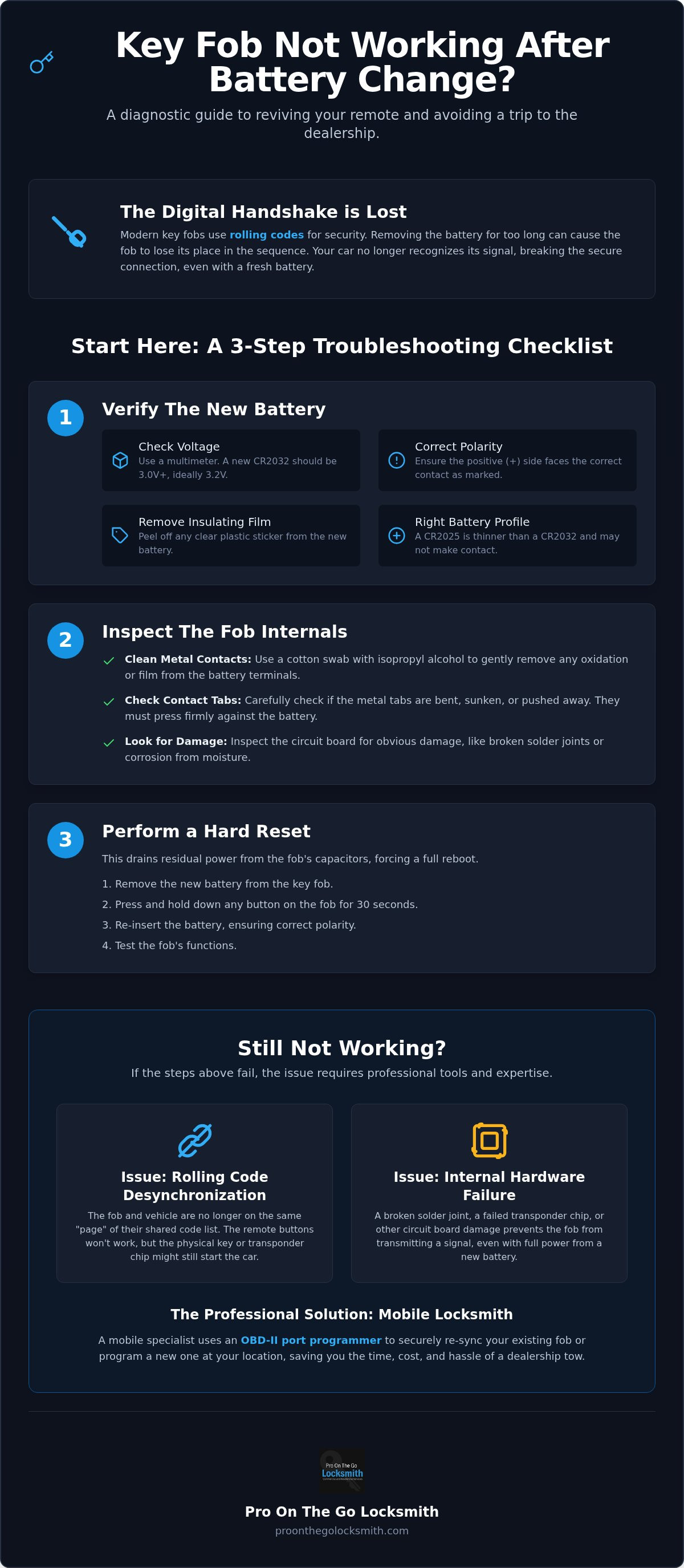
It's a common scenario: you replace a dying battery only to find the remote is completely unresponsive. When a key fob not working after battery change occurs, it's rarely because the new battery is "wrong" in a literal sense. Instead, the issue usually stems from a break in the encrypted communication between your key and the vehicle's computer. This isn't just a simple power issue; it's a software synchronization failure.
Modern vehicles utilize a Remote Keyless System that relies on rolling codes for security. Every time you press a button, the fob and the car synchronize a new, unique code from a pre-shared list. If the battery remains removed for an extended period, the fob can lose its place in this sequence. This desynchronization means the car no longer recognizes the signal as valid, effectively locking you out of the digital handshake. It's a security feature designed to prevent code grabbing, but it can become a major inconvenience during a routine maintenance task.
The Digital Handshake: How Fobs Stay Synced
Your car's Electronic Control Unit (ECU) is constantly listening for a specific encrypted signature. This protocol ensures that a signal from a neighbor's remote won't unlock your doors. When the power supply is interrupted for more than a minute or two, the internal memory of some fobs may reset. You'll know this has happened if the physical transponder chip still allows you to start the engine, but the remote buttons for locking and unlocking remain dead. The passive chip usually operates via induction and doesn't require battery power, while the active remote features are entirely dependent on that synchronized "handshake."
Common Physical Installation Errors
Before assuming the software is at fault, check for basic mechanical oversights. These small errors account for a surprising number of service calls. We often see simple fixes resolve what seemed like a terminal hardware failure.
Polarity Reversal: It's easy to flip the coin-style battery. The positive (+) side, usually marked with text, must face the correct contact.
Wrong Battery Profile: A CR2025 and a CR2032 look identical but have different thicknesses. If you use a thinner CR2025 where a CR2032 is required, the metal tabs won't make a secure connection.
The Insulating Film: Many new batteries ship with a transparent plastic sticker on the negative side to prevent discharge. If you don't peel this off, no current will flow.
If you've verified the physical setup and the key fob not working after battery change persists, the issue is likely rooted in the programming. In these cases, the fob has essentially "forgotten" its identity relative to your vehicle, requiring a professional reset to restore the connection.
Step-by-Step Troubleshooting: Fixing a Key Fob That Won’t Sync
When you're facing a key fob not working after battery change, you must approach the problem with a methodical diagnostic mindset. Don't assume the new battery is functional just because it's fresh out of the blister pack. Start by verifying the voltage with a multimeter. A standard CR2032 battery should read at least 3.0V; ideally, it should sit at 3.2V or higher. If your meter shows 2.9V or less, the battery is already too weak to power the transmitter effectively. Many "new" batteries sit on store shelves for years, losing their charge before they ever reach your pocket.
If the voltage is correct, perform a hard reset on the fob itself. Remove the battery and hold down any button for 30 seconds. This simple action drains the residual power stored in the internal capacitors, forcing the chip to reboot when you reinsert the power source. You should also consider the state of your vehicle. A weak car battery, even one that still starts the engine, can sometimes lack the necessary voltage to keep the RF receiver active. If your car battery is more than four years old, it might be the silent culprit behind the signal failure.
Inspecting and Cleaning Internal Contacts
Internal hardware requires a clean, physical path for electricity to flow. Open the casing and inspect the metal battery terminals for signs of oxidation or a dull, dark film. Use a cotton swab lightly dampened with 90% isopropyl alcohol to clean the contact pads on the circuit board. Be gentle. Avoid using abrasive materials like sandpaper, which can strip away the conductive plating. Check if the metal tabs are "sunken" or bent away from the battery. If they don't apply firm pressure to the coin cell, the circuit will remain open, leaving you with a dead remote.
Manual Re-Pairing Sequences (DIY Methods)
Older domestic vehicles often allow for a manual re-pairing "dance" to resync the system. For many Ford or GM models from the early 2010s, this involves cycling the ignition from "Off" to "Run" eight times in quick succession until the door locks cycle. This cycle signals that the car is in "learning mode." However, modern "Push to Start" vehicles have moved away from these DIY methods for security reasons. These advanced systems typically require a secure connection through the OBD-II port to authorize a new sync. If your manual attempts fail, it's likely that the software link is broken, requiring professional key fob programming to restore full functionality.
Understanding Key Fob Programming and Re-Synchronization
A key fob not working after battery change often indicates that the vehicle has "unlearned" the remote. While older cars used simple radio frequencies, modern vehicles utilize complex encrypted data streams. If the fob remains unpowered for too long, the internal volatile memory might wipe. When this happens, the physical buttons lose their authorization to command the car's locking system. It's a frustrating situation where the hardware is powered, but the software is effectively speaking a different language than the car.
Many owners confuse cloning with programming. Cloning involves copying the digital ID of an existing key onto a new one. While this works for some older models, it's a shortcut that doesn't always interface well with modern security modules. True programming involves using a diagnostic tool to tell the car's computer to accept a specific, unique key ID. This is a more secure method that ensures the car's computer is fully aware of every authorized device. It also prevents old, lost keys from potentially being used to access your vehicle.
When DIY Methods Fail: The Need for OBD-II Programming
For vehicles manufactured after 2015, security protocols have become significantly more robust. These cars require an encrypted handshake that can only be initiated through the On-Board Diagnostics (OBD-II) port. A professional locksmith uses specialized tablets to bypass the lockout and force the ECU into learning mode. This process is essential for car key transponder programming, which ensures the engine's immobilizer recognizes your key. Without this digital authorization, the car might let you inside but will refuse to start.
The Cost of Professional Programming vs. Dealerships
The most significant hurdle for many drivers is the perceived cost. Dealerships often charge a premium for programming, sometimes adding labor fees that exceed the value of the fob itself. They also typically require you to bring the car to them. If your key is dead and you can't start the engine, this means paying for a tow truck. A mobile locksmith specialist eliminates these extra costs. We bring the diagnostic equipment to your driveway, performing the same high-level programming on-site. This approach ensures all your existing keys remain functional while saving you the expense of dealership overhead and transportation fees. It's a more efficient, logical way to handle a software-based lockout.
Beyond the Battery: Identifying Internal Hardware and Chip Failures
Sometimes, a key fob not working after battery change isn't a power or programming issue. It's a structural failure. Key fobs lead a rough life. They are dropped on concrete, crushed in pockets, and exposed to high humidity. These physical stressors can cause microscopic damage to the Printed Circuit Board (PCB) inside the plastic housing. Even if the battery is brand new, a hairline fracture in a copper trace or a cold solder joint will prevent electricity from reaching the transmitter. If you've ruled out the battery and the sync, it's time to look at the hardware itself.
Inspect the tactile switches on the board. These are the tiny buttons that click when you press the rubber pad. Over years of use, the solder joints holding these switches can crack. You might feel a "click," but no electrical connection is made. Similarly, water damage can leave behind conductive mineral deposits that short-circuit the board. If you see white or green corrosion around the chipsets, the board has likely reached the end of its functional life. In these cases, repair is often more expensive and less reliable than a full replacement.
The Hidden Transponder Chip
Most modern keys contain a transponder chip that works independently of the battery. This chip is a passive security device that the car's ignition "reads" via an induction coil. If you dropped your key and the plastic shell cracked, the chip might have shifted or sustained a microscopic internal fracture. A damaged chip often results in a car key not detected error on your dashboard. Interestingly, your remote buttons might still lock and unlock the doors while the engine refuses to start. This separation of functions is why a "working" remote doesn't always mean a "working" key.
PCB Fatigue and Button Failure
PCB fatigue is a common result of "pocket torque." When you sit with your keys in a tight pocket, the fob housing flexes. Over time, this bending action snaps the delicate traces on the circuit board. You can sometimes diagnose this by gently squeezing the fob while pressing a button. If it works only under pressure, you have a broken trace or a loose component. Additionally, the conductive material on the underside of the rubber buttons can wear away. Without that conductive layer, the button can't bridge the gap on the PCB to send a signal. When hardware fails at this level, professional Car Key Replacement is the most reliable way to ensure you aren't left stranded again.
When to Call a Professional Mobile Locksmith in Tampa
When your DIY attempts fail, the situation shifts from a simple maintenance task to a technical security hurdle. A key fob not working after battery change is often the final sign that professional intervention is required. Instead of risking damage to your vehicle's sensitive ECU by following unverified online "hacks," a specialized technician provides a controlled, logical resolution. In Tampa, this means choosing a partner who understands the specific environmental and technical challenges of Florida's automotive market. We focus on restoration rather than just replacement, ensuring your existing hardware is fully evaluated before we suggest a new unit.
Our approach is methodical. We start by identifying the specific frustration, whether it's a lost rolling code or a hardware failure, and then we apply the technical remedy. This process ensures that you aren't just buying a new part, but resolving the underlying communication break between your key and your car. We maintain a strictly professional boundary while providing the neighborly expertise you expect from a local Tampa specialist. It's about moving from uncertainty to a confirmed, working result.
Mobile Service: We Come to You in Tampa
The most significant advantage of a mobile specialist is the elimination of the tow truck. Dealerships require you to bring the vehicle to their service bay, which often adds over $150 in towing fees to an already expensive bill. Pro On The Go Locksmith operates as a fully equipped mobile lab. Our technicians serve the entire Tampa area, arriving at your home, office, or roadside location with the latest diagnostic and programming software. We handle everything from standard remotes to complex proximity fobs on-site. This approach respects your time and prevents the logistical nightmare of a multi-day dealership stay. We work during our standard business hours to provide a sophisticated, reliable alternative to less-specialized competitors.
Comprehensive Diagnostic and Solution
We don't just guess at the problem. Our diagnostic process involves a full signal verification to ensure the issue isn't hidden within the car's receiver or the ignition system. If our tools determine the hardware is compromised, we provide an immediate mobile car key replacement right there on the spot. As a licensed Florida locksmith (#HCLOC23013), we prioritize transparency and professional precision. You'll receive a key that's programmed correctly the first time, ensuring all security features, including the transponder and rolling code sequences, are perfectly synchronized. This professional peace of mind is the efficient alternative to the high-stress, high-cost dealership experience. We verify the final result by testing every button and the ignition start, confirming that your vehicle's access is fully restored.
Restoring Your Access with Precision
Dealing with a key fob not working after battery change is more than a minor annoyance; it's a security lockout that requires a methodical solution. We've explored how digital desynchronization and internal hardware fatigue can render a fresh battery useless. Whether your vehicle requires a simple manual re-pairing or complex OBD-II programming, understanding the cause is the first step toward restoration. You don't have to settle for the high costs and logistical headaches of dealership towing when specialized help is available at your doorstep.
Pro On The Go Locksmith provides the expert resolution you need. As a Licensed Florida Locksmith (#HCLOC23013), we specialize in modern automotive transponder technology. Our mobile technicians serve the entire Tampa area, arriving equipped to diagnose and repair your security system on-site. We prioritize your time and safety by delivering precise results that get you back on the road without unnecessary delays. Don't let a technical sync issue disrupt your schedule any longer. Get Professional Key Fob Programming in Tampa Today and regain full control of your vehicle's access. We have a plan to get you moving again.
Frequently Asked Questions
Why does my key fob still not work after a battery change?
A key fob not working after battery change usually indicates a lost digital handshake. When power is removed, the rolling code sequence between the fob and the car can desynchronize. Other possibilities include a battery installed with reversed polarity or oxidized metal contacts that prevent a clean electrical path. If the battery is confirmed good with a multimeter, the vehicle likely needs a professional software reset to recognize the signal again.
Do I need to reprogram my key fob after changing the battery?
Reprogramming isn't always necessary, but it's common for modern proximity keys. Many vehicles maintain their memory during a quick battery swap, but if the fob was left without power for an extended period, the internal volatile memory can wipe. If the physical buttons remain dead but the key still starts the engine, it's a clear sign that the remote entry portion of the software needs a professional re-synchronization to function.
How do I know if my key fob is broken or just needs a battery?
Start by testing the new battery with a multimeter to ensure it reads at least 3.0V. If the voltage is correct, look for an LED indicator light on the fob casing when you press the buttons. A flashing light that doesn't trigger the car suggests a programming error. If there is no light despite a fresh battery, the internal circuit board has likely suffered a hardware failure, such as a broken solder joint.
Can I reprogram a key fob myself?
Manual re-pairing is sometimes possible on older domestic models using specific ignition cycles or door lock sequences. However, vehicles manufactured after 2015 typically use high-level encryption that blocks DIY attempts. These advanced systems require a secure connection through the OBD-II port using specialized diagnostic tablets. For most modern smart keys, a licensed locksmith is necessary to safely access the vehicle's computer and authorize the new synchronization without risking a system lockout.
Will a dead key fob battery cause my car not to start?
A dead battery won't usually stop a traditional turn-key car from starting because the transponder chip is passive. However, for "Push to Start" vehicles, the car must detect a signal to enable the ignition. If the battery is dead, you can typically use an emergency override. Most manufacturers design the start button or a specific steering column slot to read the key's chip inductively when held in close proximity, even without battery power.
How much does it cost to have a locksmith program a key fob in Tampa?
Programming costs depend on your vehicle's specific security protocol and the type of key fob you own. Dealerships often include high labor rates and require you to tow the vehicle to their location, which adds to the total expense. A mobile locksmith offers a more logical alternative by performing the service at your location. This on-site approach eliminates towing fees while providing the same precision programming required for modern automotive security systems.
What should I do if my car key is not detected after a battery swap?
If your vehicle displays a "key not detected" message, first try holding the fob directly against the start button. If the key fob not working after battery change continues, the internal transponder chip might have lost its link to the immobilizer system. A mobile locksmith can connect to your car's diagnostic port to verify if the chip is transmitting correctly or if the security module needs a fresh authorization sequence.
Why are my key fob buttons working but the car won’t start?
This symptom points to a failure in the transponder chip, which operates independently from the remote entry buttons. While the battery powers the radio signal for the locks, the engine immobilizer relies on a separate chip to authorize the ignition. If that chip is damaged or desynchronized, the car won't start even if the remote buttons work perfectly. Resolving this requires a specialist to re-link the transponder chip to the vehicle's security module.


