
Honda Transponder Key Programming: The Complete 2026 Guide

Updated: Sep 14
What if the most expensive component in your vehicle isn't the engine, but the tiny microchip embedded in your key? When your Honda fails to start and that green immobilizer light flashes on the dashboard, the anxiety of a lockout sets in instantly. You are likely weighing the high cost of a dealership service against the technical confusion of a DIY repair. It's a difficult spot to be in; you want a reliable solution that doesn't risk damaging your car's sensitive electronics. Mastering Honda transponder key programming is about more than just cutting metal. It is about establishing a secure digital handshake between your key and the vehicle’s computer.
This guide provides the technical clarity you need to get back on the road without the dealership price tag. You will discover the most reliable ways to program your key while protecting your car's ECU from permanent damage. We will preview the cost-to-value ratios for different Honda models and explain why specialized tools are now a requirement for modern security systems. By the end, you'll have a professional's perspective on restoring your access quickly and safely.
Table of Contents
Understanding Honda Transponder Key Programming
Many drivers are surprised when a newly cut key turns the ignition but fails to start the engine. This frustration happens because a physical key cut represents only 50% of the replacement process. The remaining half is the digital authentication. A Honda transponder key is a sophisticated security device containing a miniature RFID chip embedded in the plastic head. Without the correct digital signature, your vehicle remains a stationary piece of hardware. This is the reality of modern automotive security; it's a digital lock that requires a digital key.
The Honda Immobilizer System acts as a silent sentry. It's an electronic deterrent that communicates directly with the Engine Control Unit (ECU). If the system detects a key with an incorrect or missing chip, it disables the fuel pump and ignition system. While this technology has dramatically reduced vehicle theft rates across the country, it also means that Honda transponder key programming is a mandatory step for every modern owner. You aren't just buying a piece of metal; you are authorizing a new device to access your car's brain.
How the Digital Handshake Works
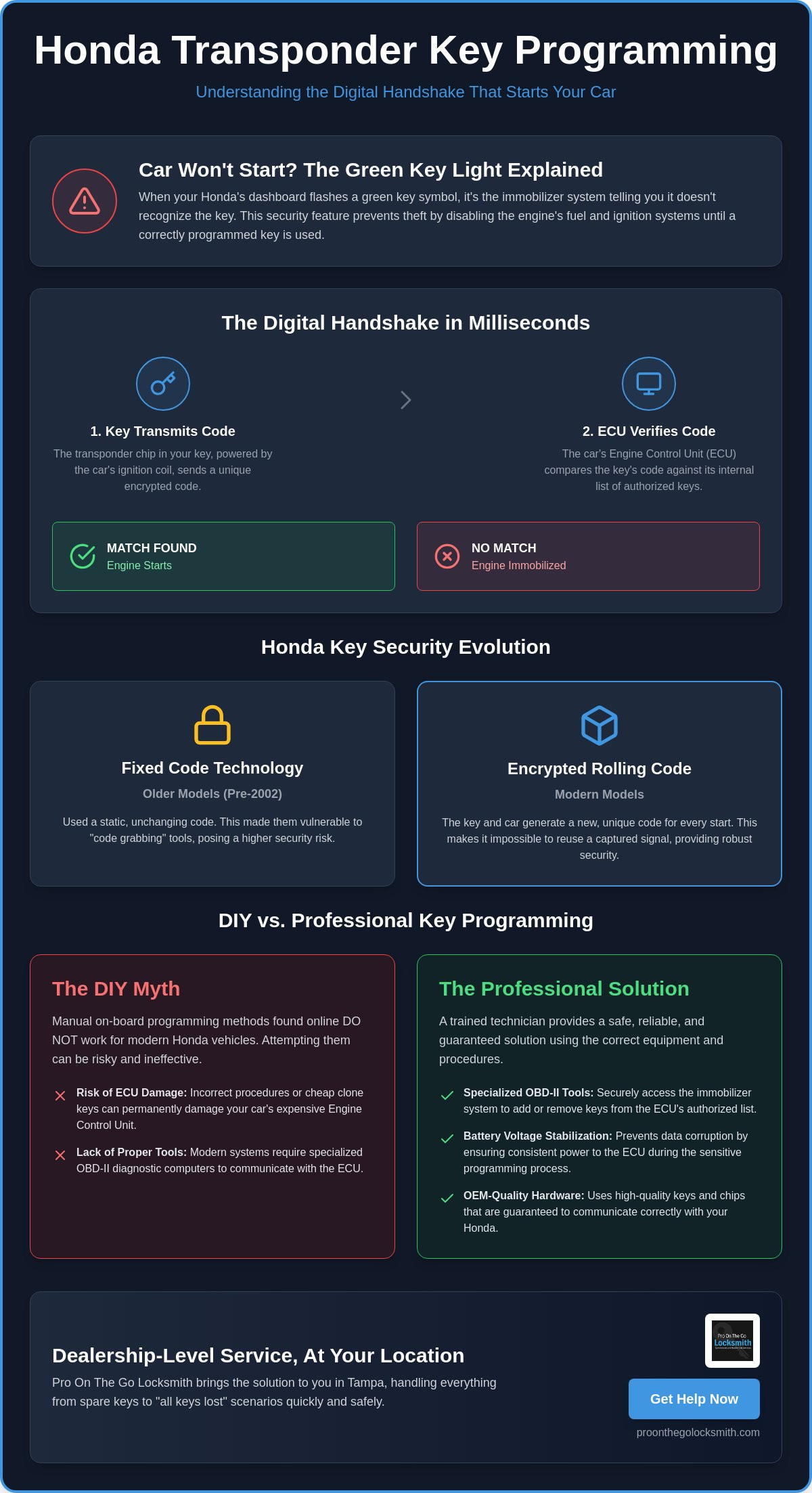
The interaction between your key and car is a precise digital handshake that occurs in milliseconds. When you turn the key or press the start button, an induction coil near the ignition sends a burst of energy to the key's transponder chip. This passive chip doesn't need its own battery; it uses that electromagnetic energy to broadcast a unique alphanumeric code back to the vehicle. The ECU receives this code and compares it to its internal whitelist. If there's a match, the engine starts. If not, the immobilizer light flashes, and the car remains immobilized. Understanding How Immobilizer Systems Work helps clarify why you can't simply bypass this step with a basic hardware store key copy.
Fixed Code vs. Rolling Code Technology
Honda security has evolved through two distinct phases to keep up with modern theft methods. Older models, generally those manufactured before 2002, utilized fixed code technology. These systems used a static code that never changed, which made them vulnerable to "code grabbing" devices used by sophisticated thieves. Modern Honda vehicles now employ encrypted rolling code systems. Every time you start the car, the ECU and the key generate a new digital signature for the next start. This constant evolution makes Honda transponder key programming a task for specialized diagnostic computers rather than simple manual overrides. It ensures that even if someone manages to copy your digital signal once, they won't be able to use it a second time.
How Honda’s Immobilizer System Protects Your Vehicle
The primary goal of Honda's security engineering is to ensure that only the rightful owner can operate the vehicle. This is achieved through a multi-layered defense strategy centered on the immobilizer system. Research suggests that vehicle immobilizers are effective mechanisms for reducing car theft. In fact, industry data indicates that the introduction of transponder technology helped reduce Honda theft rates by over 50% compared to older mechanical-only models. This protection is robust, but it creates a specific requirement for Honda transponder key programming whenever you need a spare or replacement.
It's vital to distinguish between two different types of programming. Many owners assume that if their remote buttons lock and unlock the doors, the key is fully functional. This is a common misconception. Remote entry programming handles the convenience features, while engine start programming authorizes the transponder chip to bypass the immobilizer. You might have a key that opens the trunk but fails to start the engine because the digital handshake hasn't been completed. Professional Honda transponder key programming ensures both systems are perfectly synced with your vehicle's specific security protocols.
The Role of the ECU in Key Recognition
The Engine Control Unit, or ECU, serves as the vehicle's central nervous system. The ECU is the digital brain that validates the transponder signal before allowing the fuel system to engage. It maintains a permanent, encrypted whitelist of authorized key IDs in its memory. When you perform programming, you are essentially writing a new entry into this secure database. Attempting to "brute force" the system or using unverified, low-quality software can lead to disastrous results. You risk corrupting the ECU firmware; this often leads to a total vehicle lockout and an expensive replacement of the entire control module.
Because the ECU is so critical, any work involving module access requires specialized expertise; for owners of American performance vehicles looking for advanced tuning beyond basic security, you can explore PCM & TCM Unlocking Services to safely manage your vehicle's calibration.
Dashboard Warning Signs
Your Honda is designed to communicate its security status through visual indicators. The most prominent is the "Green Key" light on the dashboard. Under normal conditions, this light should illuminate briefly when you turn the ignition and then disappear. If the light continues to flash rapidly, it means the immobilizer does not recognize the key. This often happens with poorly programmed aftermarket keys or if the transponder chip has been damaged.
For owners of newer push-to-start models, you might encounter a "key not detected" error message instead. This can be caused by a weak key fob battery or electronic interference. If you find yourself stuck, troubleshooting car key not detected issues often starts with checking the basic proximity of the fob to the start button. If these basic steps fail, you may need a specialist to perform a Car Key Replacement to restore full functionality to your vehicle.
DIY vs. Professional Honda Key Programming: What Actually Works?
The internet is full of "hacks" promising that you can program a new car key using nothing more than a paperclip and a specific sequence of brake pedal presses. While these methods might have worked on a 1998 Accord, they are a dangerous myth for 2026 models. Modern Honda security doesn't rely on simple on-board sequences. Instead, it requires a secure connection to the vehicle’s Diagnostic Link Connector (DLC) to authorize new hardware. Attempting a DIY fix without the proper software often leads to a "dead" key and, in some cases, can accidentally de-program your only working key. You're then left with a non-starting vehicle and a mandatory tow to a specialist.
When it comes to Honda transponder key programming, the hardware is only as good as the software used to pair it. Many owners try to save money by purchasing cheap "clones" or unverified keys from online marketplaces. These keys often use inferior chips that fail to maintain a stable digital signature. The National Automotive Service Task Force (NASTF) outlines the rigorous data security standards required to access vehicle immobilizer data safely. Professional tools ensure that the pairing process is permanent and doesn't interfere with other sensitive systems like Honda Sensing or the central locking module.
When DIY is (Rarely) Possible
There are very specific scenarios where a DIY approach might yield partial results. Some older Honda models allow you to program the remote entry functions (the lock and unlock buttons) through a manual process. However, this does not program the transponder chip required to start the engine. You might also see "cloning" machines at big-box hardware stores. These devices simply copy the ID of your existing key onto a blank one. While this works as a temporary backup, it doesn't add a new, unique key ID to the car's memory. If you lose the original, the clone may lose its authorization too.
The Professional Advantage
Choosing a professional for Honda transponder key programming provides a level of security that a DIY attempt cannot match. Specialists use proprietary diagnostic computers that can bypass "all keys lost" scenarios and clear out old, stolen keys from the vehicle's memory. This is especially critical for the 2026 security protocols which use higher levels of encryption. For a deeper dive into the software side, check out our guide on automotive key fob programming. You get a functional, OEM-quality key without the stress of potentially damaging your car's expensive ECU.
The Step-by-Step Process of Programming a Honda Key
Successful Honda transponder key programming is a methodical diagnostic procedure that requires more than just a software connection. The first and most critical step is vehicle preparation. Technicians must ensure battery voltage stabilization throughout the entire process. If the car's battery dips below a specific threshold while the computer is writing data to the Engine Control Unit (ECU), the process can fail, potentially "bricking" the module. We use a dedicated power supply to maintain a steady 12.5 to 13 volts, ensuring the digital handshake is completed without interruption.
OBD-II Port Access
The technician begins by locating the OBD-II port, typically found under the driver's side dashboard. A high-end diagnostic scanner is connected to this port to establish a secure link with the vehicle’s internal network. Modern 2026 Honda models feature advanced firewalls designed to prevent unauthorized access. Professional-grade equipment is necessary to bypass these security layers and gain permission to modify the immobilizer whitelist. This isn't a simple "plug and play" task; it involves a secure authentication process with the car’s gateway module.
Once access is granted, the next priority is security maintenance. If you are replacing a lost or stolen key, we perform a "clear all keys" command. This function wipes the vehicle's memory of any previously programmed keys. It's a vital security step that ensures anyone who finds your old key won't be able to start the engine. After the memory is cleared, the new transponder chip is introduced to the system. The diagnostic tool sends a command to the immobilizer to pair with the unique ID of the new chip, permanently authorizing it for use.
Final Testing Protocols
The process isn't finished until we complete a rigorous verification phase. We test the ignition response to ensure the engine starts instantly without the "Green Key" light flashing. We also verify that all auto key fob replacement features, such as proximity unlocking and trunk release, are fully synced. Range testing is performed to confirm the key communicates correctly from a standard distance. If you're currently stuck with a non-starting vehicle, our professional Transponder Key Programming service provides a factory-standard resolution directly at your location.
Finally, we provide the owner with a brief consultation on maintaining their new hardware. This includes checking fob battery health and understanding how to use the emergency physical key blade hidden inside the remote. This methodical approach ensures that your Honda transponder key programming isn't just a quick fix, but a long-term restoration of your vehicle's security and convenience.
Professional Honda Key Services in Tampa: Why Choose Pro On The Go
Facing a lockout in Tampa shouldn't mean a three-day ordeal at the dealership. Pro On The Go Locksmith offers a streamlined alternative to the traditional service center model. We provide Honda transponder key programming on-site; this means we bring the diagnostic lab directly to your driveway. You avoid the logistical headache and the unnecessary expense of a tow truck. Whether you drive a Civic, Accord, or CR-V, our mobile units are equipped with the same high-level encryption tools used by factory technicians. We handle the technical heavy lifting so you can focus on your day.
Transparency is a core part of our professional boundary. Dealerships often tack on "diagnostic fees" or "environmental charges" that inflate the final bill unexpectedly. Pro On The Go Locksmith prioritizes clear expectations and honest communication. Our technicians are specialists who focus exclusively on automotive security; they aren't general handymen. This specialization allows us to resolve "all keys lost" situations efficiently, even for the most advanced 2026 proximity systems. We don't just provide a key; we provide a verified security solution that matches your car's original factory standards.
Serving the Greater Tampa Bay Area
We understand the urgency of a non-starting vehicle. Our local team provides rapid response times throughout the Tampa area, ensuring you aren't stranded for long. Choosing an independent locksmith over a national franchise means you're working with neighbors who know the local terrain and value your time. Pro On The Go Locksmith maintains Florida license #HCLOC23013 for customer peace of mind, ensuring your vehicle's security is in verified, professional hands. We are a localized, tech-savvy partner dedicated to keeping Tampa drivers on the move.
Comprehensive Honda Solutions
Our capabilities extend far beyond simple pairing. We offer mobile car key replacement and ignition repair for every generation of Honda security. From traditional transponders to the latest smart keys and proximity fobs, we handle the digital and mechanical restoration in one visit. This comprehensive approach ensures that the physical cut and the digital signature are perfectly aligned. Don't let a lost key or a flashing immobilizer light disrupt your schedule. Schedule your Honda key programming service today and experience a more sophisticated, reliable way to get back on the road.
Restoring Your Honda's Security and Access
Your vehicle’s security depends on a precise digital handshake between the transponder chip and the Engine Control Unit. As we have explored, a physical key cut is only half the solution; the real work happens through the OBD-II port. Professional Honda transponder key programming ensures that your car remains protected from theft while preventing expensive damage to sensitive electronic modules. By choosing a specialist, you avoid the risks of inferior clones and unreliable DIY sequences that can leave you stranded.
Pro On The Go Locksmith provides the sophisticated, mobile on-site service you need to get back on the road without the dealership hassle. We utilize specialized Honda diagnostic tools and maintain Florida License #HCLOC23013 to ensure every job meets factory standards. Whether you're facing an "all keys lost" emergency or simply need a reliable spare, we have a plan to restore your access quickly and safely. Get Expert Honda Key Programming in Tampa Now. You don't have to navigate a lockout alone; help is just a phone call away.
Frequently Asked Questions
Can I program a Honda transponder key myself?
You cannot program a modern Honda transponder key yourself because the vehicle requires a secure connection to the OBD-II port to authorize new hardware. While some older models allowed manual remote entry pairing, the engine-start security is locked behind a digital firewall. Specialized diagnostic equipment is necessary to communicate with the car's computer system and establish a permanent digital handshake.
How much does Honda transponder key programming cost in Tampa?
The total investment for Honda transponder key programming in Tampa varies based on the vehicle’s year and the type of key required. Locksmiths typically provide a more affordable alternative to dealerships by offering mobile services that eliminate the need for a tow truck. You should request a quote based on your specific model and location to ensure you get a transparent price without hidden diagnostic fees.
What is the difference between a transponder key and a remote fob?
A transponder key contains an RFID chip that communicates with the ignition to start the engine, while a remote fob handles convenience features like locking and unlocking doors. Many modern Honda keys combine both into a single unit. It is possible for a remote to function perfectly while the transponder remains unprogrammed; this results in a key that opens the doors but fails to start the car.
Will a new key work if my Honda immobilizer light is flashing?
A new key will not start the vehicle as long as the immobilizer light is flashing on the dashboard. This indicator confirms that the car's security system has detected a key it doesn't recognize. You must complete the Honda transponder key programming process to sync the new chip with the vehicle's memory and clear the security lockout.
Can a locksmith program a Honda key if I lost all the originals?
A specialized automotive locksmith can program a new key even in an "all keys lost" scenario. Technicians use diagnostic tools to access the vehicle's ECU, reset the immobilizer memory, and authorize new keys from scratch. This process also allows the technician to wipe the old, lost keys from the system, ensuring that they can no longer be used to start your vehicle.
How long does the Honda key programming process take?
The programming process typically takes between 20 and 45 minutes depending on the complexity of the vehicle's security system. This timeframe includes the initial diagnostic connection, the digital pairing process, and a series of verification tests to ensure the engine starts reliably. Newer models with advanced proximity features may require slightly more time to navigate the latest encryption protocols.
Do I need the car present for the key to be programmed?
The vehicle must be present because the programming software needs to establish a physical connection with the car's internal network via the OBD-II port. The process involves writing new data to the vehicle's computer, so it is impossible to program a key using the key alone. Our mobile units resolve this by bringing the necessary technology directly to your driveway or workplace.
Why does my Honda key turn in the ignition but the engine won’t start?
If the key turns but the engine fails to fire, the immobilizer system is likely blocking the ignition because it hasn't verified the transponder chip. This means the mechanical cut of the key is correct, but the digital signature is either missing or incorrect. A professional technician can diagnose whether the chip is damaged or if the key simply needs to be re-synced with the vehicle's computer.
For mobile assistance, see our transponder key programming service in Tampa.


