
Front Door Lock Stuck in Tampa? How to Diagnose It Safely

What if the problem isn’t the lock at all, but the way the door meets its frame? If you’re searching “front door lock stuck Tampa,” it’s understandable to worry that another turn could snap the key or make the damage worse. A key that won’t turn, a deadbolt that won’t extend, or a door that only locks when pushed can each point to a different cause. Forcing it rarely clarifies which one.
This guide will help you narrow down the likely source of the problem and try a few low-risk checks without putting extra strain on the key or hardware. You’ll also learn when to stop troubleshooting and arrange mobile locksmith help in Tampa.
We’ll look at clues that distinguish a worn or damaged key from a sticky lock, loose hardware, or a door-alignment issue. Then we’ll cover simple checks you can do safely, what to avoid, and what a mobile locksmith can assess before recommending a suitable next step. The goal is straightforward: restore reliable access and security without turning a stubborn lock into a bigger problem.
Table of Contents
Front Door Lock Stuck in Tampa? Start by Identifying the Symptom
If you searched “front door lock stuck Tampa,” start by observing what the key, knob, latch, deadbolt, and door are doing. A clear description is more useful than guessing at a repair. A stuck front door lock is a symptom with several possible mechanical causes, and the same frustrating result can come from different parts of the lock or door.
First, separate the moving parts. Does the key enter and turn? Does the knob move while the latch stays in place? Does the key turn while the deadbolt remains extended? Those details help narrow down what may be happening, but they don’t confirm a failed part on their own. A lockset includes components such as a latch bolt, deadbolt, and strike plate; Understanding Lockset Components and Grades can help you identify which part you’re observing.
Use this symptom-to-area guide as a starting point, not a diagnosis:
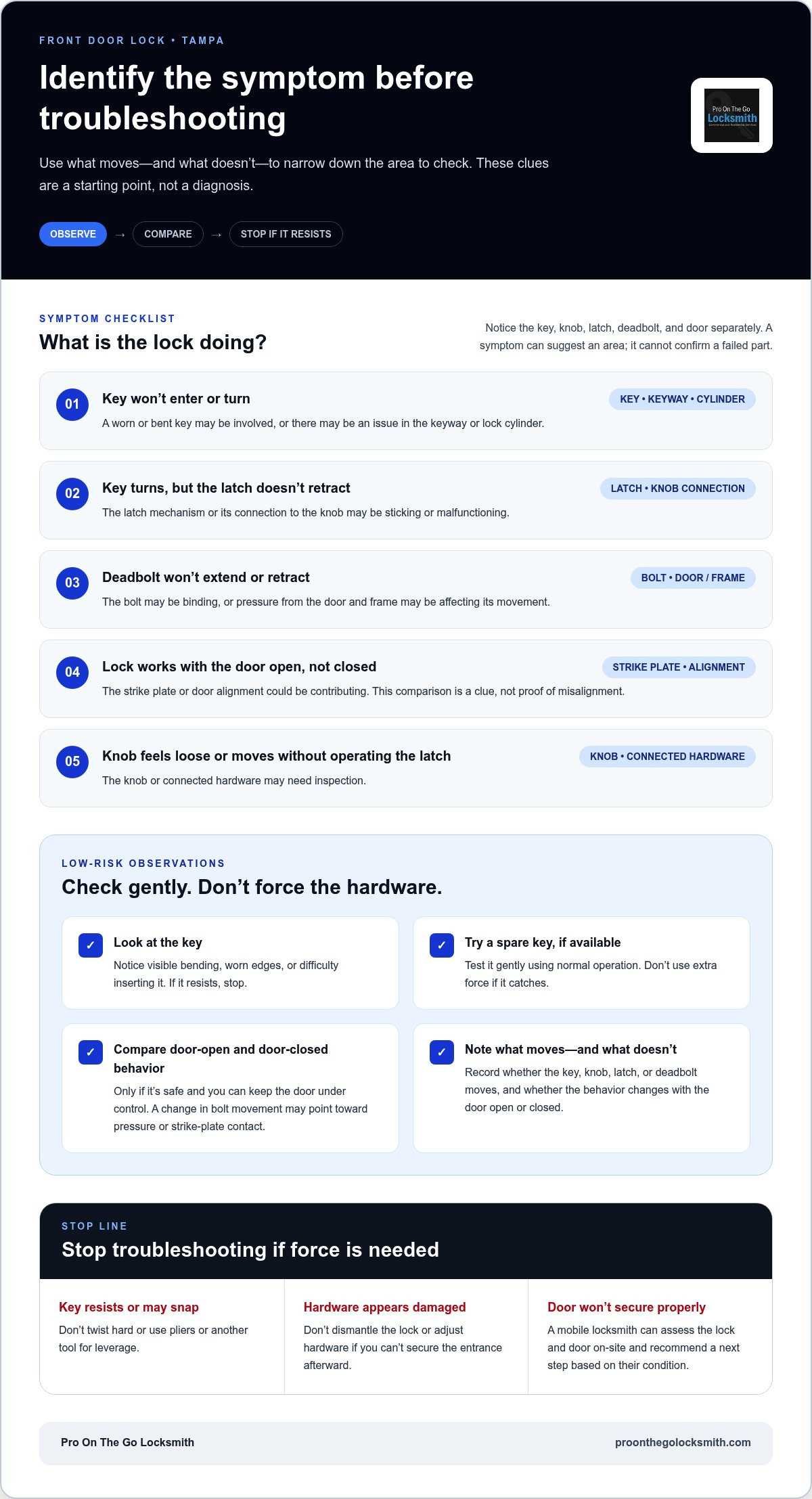
Key won’t enter or turn: The key may be worn or bent, or there may be an issue in the keyway or lock cylinder.
Key turns, but the latch doesn’t retract: The latch mechanism or its connection to the knob may be sticking or malfunctioning.
Deadbolt won’t extend or retract: The bolt may be binding, or pressure from the door and frame may be affecting its movement.
Lock works with the door open but not closed: The strike plate or door alignment could be contributing, though this test alone can’t confirm the cause.
Knob feels loose or moves without operating the latch: The knob or connected hardware may need inspection.
Does the key turn, stop partway, or refuse to enter?
Notice whether the key slides fully into the keyway, the slot that accepts it, and whether it rotates smoothly through its normal movement. A key that won’t enter points attention toward the key or keyway; one that enters but stops during rotation may involve the key or cylinder. Check for visible bending, worn edges, or difficulty inserting it. If it resists, stop. Don’t twist hard or use pliers or another tool for leverage.
Is the deadbolt stuck, or is the door pressing against the frame?
If it’s safe and you can keep the door under control, observe whether the lock behaves differently with the door open. A deadbolt that moves with the door open but binds when closed may be responding to pressure or a mismatch with the strike plate. That’s a clue, not proof of misalignment. If the key turns but the bolt still won’t retract, the issue may lie within the lock mechanism rather than the key itself.
Record what moves, what doesn’t, and whether the behavior changes with the door open or closed. That symptom picture helps distinguish a key issue from a latch, bolt, or door-fit problem without forcing the hardware.
Why a Front Door Lock Gets Stuck: Key, Latch, or Door Alignment
A front door lock can resist because of trouble with the key, the lock cylinder, the latch, or the way the door meets its frame. Each part affects a different stage of locking: the key operates the cylinder, the cylinder moves the latch or deadbolt, and the bolt must line up with the strike plate in the frame. A search for “front door lock stuck Tampa” may turn up quick fixes, but the symptom alone can’t identify which part has failed or what service is appropriate.
Common symptoms can point toward possible areas to inspect, without confirming a diagnosis:
Key is hard to insert or turn: A worn or bent key, debris in the keyway, or a cylinder issue may be involved.
Key turns, but the latch or bolt doesn’t move as expected: The cylinder, latch mechanism, or connecting hardware could be binding or worn.
Bolt moves when the door is open but binds when closed: Pressure against the frame or a mismatch at the strike plate may be contributing.
Knob or latch movement feels rough: Friction or wear in the latch assembly may affect operation.
How key and cylinder problems can affect turning
A key’s cuts and shape need to match the lock. If the key is bent or worn, it may not align smoothly with the cylinder’s internal components. Trouble can also come from inside the cylinder, even if the key looks intact. Compare the key’s condition with how the lock responds, and avoid repeated attempts if it catches. A key that bends or feels firmly stuck could break inside the lock if you keep applying force.
How a latch, strike plate, or shifted door can cause binding
A deadbolt or latch needs room to move into its opening in the strike plate. If the door presses against the frame or the bolt meets the edge of that opening, the lock may feel jammed even though the key turns. Wear or friction in the latch can also interfere with movement. Observe whether the door rubs or sits unevenly, but don’t adjust the hardware yourself if you can’t secure the entrance afterward.
Door movement can also change how the lock and frame meet. Temperature or moisture may affect some doors or surrounding materials, but that’s only one possible factor, not a guaranteed explanation for a stuck lock in Tampa. A change in behavior over time can be useful context, yet it doesn’t prove the door has shifted or identify a repair.
The useful takeaway is simple: a difficult key may point toward the key or cylinder, while a bolt that binds against the frame may involve door fit or the strike plate. These are possibilities, not promises of a particular fix. If the cause remains unclear, an on-site assessment can help distinguish a lock mechanism issue from binding at the door. Avoid adjusting hardware yourself if the work could leave your home unsecured.
Safe Checks to Try Before Calling a Tampa Locksmith
If you searched “front door lock stuck Tampa,” start with a careful check rather than a forceful fix. The goal is to observe what the lock does, try only normal operation, and avoid adding strain. If the door is open, make sure you can keep the entrance secure while checking it. Don’t dismantle the lock or try to bypass it.
Observe the failure. Note whether the key enters and turns, and whether the knob, latch, or deadbolt moves. Listen for scraping or grinding, and notice if the resistance changes.
Inspect the key. Look for visible bending or damage before using it again. Don’t test the lock with a key that appears damaged.
Try a spare key, if readily available. Insert and turn it gently with normal motion. If it binds too, stop instead of repeating the attempt.
Check for door pressure. If the door is closed and secure, apply only light pressure toward or away from the frame while operating the lock normally. Notice whether bolt movement changes. Don’t push hard or force the key.
Compare open and closed operation, only if safe. If the door is already open and you can control it, observe whether the latch or bolt moves normally. Don’t leave the entrance unsecured during the check.
Stop at warning signs. A bending key, increasing resistance, or a new grinding or scraping sound means you should stop.
Low-risk checks for a key that will not turn
Inspect the key in good light, paying attention to its shape and edges. If it looks intact and a spare is readily available, try that key gently once. If it catches too, don’t alternate keys or twist harder. Avoid pliers, improvised leverage, and unverified oils or other substances in the keyway; they can add strain or complicate an inspection without resolving the cause.
Checks for a bolt or latch that will not move
If the door is closed, a small change in pressure may reveal whether the bolt is binding against the frame, though it can’t confirm the cause. If the door is safely open, operate the knob or lock once with its normal motion and observe whether the latch retracts. Don’t remove components or adjust the frame, especially if you can’t secure the entrance afterward.
Increasing resistance is a reason to stop rather than apply more force. If gentle checks don’t clarify the issue, note what you observed and arrange an on-site assessment instead of risking a broken key or further damage. If your search for “front door lock stuck Tampa” brought you here and the lock still won’t operate safely, contact a Tampa locksmith for help.
When to Stop DIY Troubleshooting and Get Professional Help
Knowing when to stop is part of a safe diagnosis. If the key is bending, resistance is increasing, the lock appears damaged, or gentle checks haven’t helped, further attempts can turn a difficult lock into a broken key or a door that won’t secure. If you can’t enter or secure your home safely, treat that as an access and security problem, not a reason to keep experimenting.
Stop if the key may snap. A bent key or one that catches firmly can break inside the cylinder if you twist harder.
Stop if the lock or hardware is damaged. Loose components, visible damage, or worsening grinding and scraping can signal that more force may worsen the problem.
Get help if the door won’t secure. A lock that won’t latch or a deadbolt that won’t extend can leave the entry unsecured.
Move on if gentle checks fail. Repeating the same test is unlikely to identify the underlying cause and may add strain.
A stuck lock doesn’t automatically need to be replaced. The issue may involve a key, cylinder, latch, or the way the door meets its frame, and those possibilities call for different next steps. An assessment helps determine whether rekeying is suitable or whether changing the lock is the more appropriate option.
Signs further force could make the problem worse
Pay attention to changes: resistance that increases with each turn, a key that begins to bend, hardware that shifts or feels loose, or grinding that gets louder or newly appears. Forcing the key can leave it broken inside the cylinder or worsen existing damage. Don’t try to bypass the lock. Stop, keep clear of any unstable hardware, and focus on whether the door can be secured.
What a Tampa locksmith can assess on-site
A mobile technician can inspect the key and cylinder, check how the latch or bolt moves, and observe how the door and frame interact. That on-site assessment helps separate a lock-mechanism problem from binding at the door. The findings guide the recommendation, rather than assuming every stuck lock needs replacement.
Rekeying changes which key operates a compatible lock, while changing the lock replaces hardware. Those are different decisions from resolving a jam or binding issue. An article on rekeying versus changing locks can help explain the distinction; the suitable option depends on the condition of your lock and door.
If your front door lock stuck in Tampa won’t operate after gentle checks, or you can’t secure the entry, an on-site assessment is a practical next step. Arrange a Tampa locksmith assessment so the lock and door can be evaluated before a suitable service is recommended.
How Mobile Locksmith Help Works for a Stuck Front Door Lock in Tampa
If safe checks haven’t resolved the problem, an on-site assessment can help identify what’s affecting the lock. Pro On The Go Locksmith provides mobile residential locksmith services in Tampa, including house lockout assistance and residential lock rekeying. The company also handles lock changes. Service is available during business hours, and the appropriate next step depends on the condition of the lock and door hardware.
Before requesting help, note what you’ve observed. You don’t need to diagnose the issue yourself. Details about your “front door lock stuck Tampa” situation can help the technician understand the access problem and assess it on-site.
What information helps describe the problem
Explain whether the key enters, turns smoothly, catches, or becomes stuck. Describe whether the door opens, and whether the issue affects the deadbolt, handle latch, or both. If the lock’s behavior changed, share what you noticed and when it began. These observations help the technician assess the problem without requiring you to identify a failed part.
Key: Does it insert and turn, or resist either movement?
Door: Can you open and close it, and can you secure it?
Lock parts: Is the deadbolt, handle latch, or both affected?
Change in behavior: Did the issue start suddenly or develop over time?
If you’re locked out, say so. If you’re inside but can’t secure the door, make that clear too. These situations create different access concerns, and accurate details help the technician understand what needs attention.
What happens after the technician assesses the lock
The technician can inspect the key and cylinder, check how the latch or bolt moves, and assess how the door hardware meets the frame. This helps locate the failure point instead of assuming that a difficult-to-turn key means the entire lock needs replacing. The recommendation will depend on what the inspection shows.
Depending on the condition of the hardware, a suitable next step may involve rekeying a compatible lock or changing the lock. Rekeying changes which key operates the lock, but it won’t resolve every mechanical fault. A lockout also doesn’t automatically mean the hardware needs replacement.
Pro On The Go Locksmith operates under Florida license #HCLOC23013. If “front door lock stuck Tampa” describes your situation and you need an on-site assessment during business hours, request residential locksmith service in Tampa. Share what the key, latch, deadbolt, and door are doing so the technician can assess the symptoms and recommend a suitable next step.
Take the Next Step Toward a Reliable Front Door
If “front door lock stuck Tampa” describes your situation, you don’t need to guess at the cause before getting help. Make a note of what you’ve noticed, keep the key and lock free from further force, and focus on restoring dependable access and security. A clear next step can replace uncertainty with a plan.
Before arranging service, consider what you need most: getting back inside, securing a door that won’t latch, or understanding whether rekeying or changing the lock is appropriate. Sharing that priority helps keep the assessment focused on the problem affecting your home. If the door can’t be secured, treat that as the immediate concern.
Pro On The Go Locksmith provides mobile locksmith services in Tampa and operates under Florida license #HCLOC23013. Request mobile locksmith help for your Tampa front door lock and take a practical step toward resolving the issue. Describe what the key, latch, deadbolt, and door are doing so the technician can assess the situation and recommend a suitable service.
Frequently Asked Questions
Can I use lubricant on a front door lock that is stuck?
Use lubricant only if the lock manufacturer recommends a suitable product for that lock, and follow its directions. Avoid spraying household oil or an unknown substance into the keyway, since it may leave residue or complicate an inspection. If the key still catches after an appropriate product is used as directed, don’t keep applying more. The lock may have a mechanical problem that lubricant won’t resolve.
Why does my deadbolt work with the door open but not when it is closed?
The bolt may be meeting resistance from the door frame or strike plate when the door is shut. For example, if the door has settled or the bolt opening no longer lines up neatly, the deadbolt may move freely in open air but bind under pressure. That behavior is a clue, not proof of the cause. Avoid filing or shifting hardware until the door and lock have been assessed.
Can a stuck front door lock trap me inside my home?
It can prevent a door from opening, depending on the lock and the specific failure, so don’t assume the interior control will work normally. If the door won’t open, use another safe exit if one is available. If you’re in immediate danger or can’t leave safely, contact emergency services. Once safe, arrange a residential locksmith assessment in Tampa to address the access problem.
Should I keep trying a spare key if the first key will not turn?
No. If a spare key is readily available, make one gentle attempt using its normal motion. If it also catches, stop rather than switching back and forth or twisting harder. A spare that works normally may suggest the original key is worn or damaged, but it doesn’t establish that as the only issue. Keep both keys available so a technician can compare them during an assessment.
Can a locksmith fix a stuck lock without changing it?
Possibly. A lock doesn’t automatically need replacement just because it sticks. After inspecting the mechanism and how the door meets its frame, a locksmith can determine whether the existing hardware can be addressed or whether another option is more appropriate. Rekeying changes which key operates compatible hardware, but it isn’t the same as resolving every mechanical fault. The lock’s condition determines the suitable next step.
Does Tampa humidity make front door locks stick?
Humidity can be one possible factor, but it doesn’t explain every lock problem in Tampa. Moisture may contribute to corrosion in exposed exterior mechanisms, while changes in temperature or moisture can also affect some doors and surrounding materials. A lock that becomes difficult to operate after damp weather may offer useful context, but that timing alone can’t confirm the cause. Describe the pattern during an on-site assessment.
What should I do if my key breaks inside the front door lock?
Stop turning the lock, and don’t push the broken piece farther in or probe the keyway with a pin, knife, or other tool. If you have another safe way into the home, use it without forcing the damaged lock. Keep the remaining key piece for reference and arrange a residential locksmith assessment. Extraction depends on where the fragment is lodged and the condition of the cylinder.


