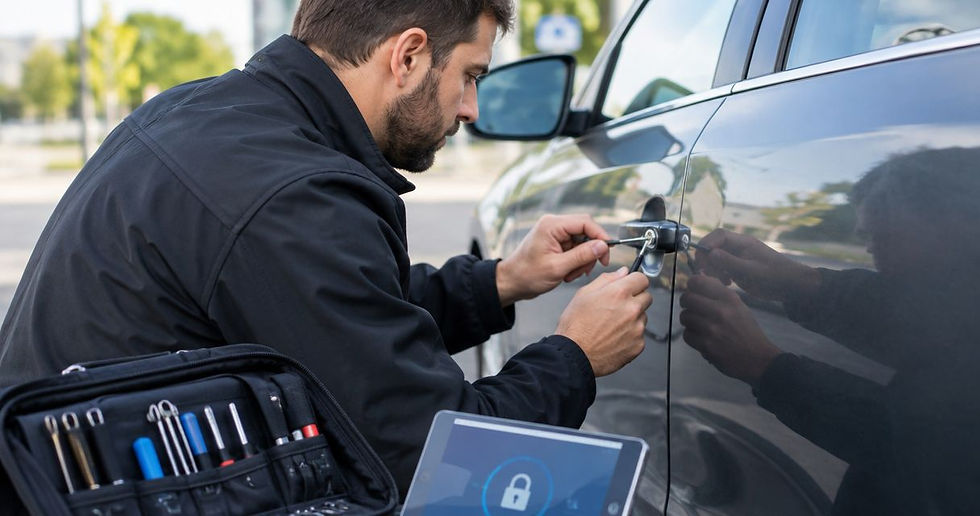
DIY vs. Professional Car Key Programming: Is It Worth the Risk in 2026?

Updated: Sep 24
What if the sixty dollar "plug-and-play" tool you found online actually turns your car into a two-ton paperweight? It is a question more Tampa drivers are asking as vehicle security becomes increasingly digital. You have likely seen the conflicting YouTube tutorials or felt the sting of a high dealership quote. It's natural to want a faster, cheaper way to get back on the road. When weighing DIY vs professional car key programming, the stakes involve more than just a working remote. They involve the integrity of your car's entire electronic control unit.
We understand the anxiety of being stranded and the desire to avoid overpaying. This article will help you navigate the critical differences between consumer-grade kits and specialist services to protect your vehicle and your wallet. We'll look at why modern immobilizers are harder to crack in 2026, the specific risks of accidentally wiping your car's memory, and how a mobile professional provides a diagnostic result that a basic tool simply cannot match.
Table of Contents
The Evolution of Car Key Security: Why Programming Matters
Your car's ignition is no longer a simple mechanical switch. In the past, a locksmith could replicate a key by simply mimicking the physical "teeth" of the original metal blade. Today, that physical cut is only half of the equation. Modern vehicle security relies on encrypted digital signatures. This shift has turned car keys into sophisticated communication devices that must be paired with the vehicle's computer. Understanding this technology is the first step in deciding between DIY vs professional car key programming for your specific vehicle. If you have a key that is perfectly cut but remains unprogrammed, the engine will simply refuse to start. The car remains silent because the digital handshake failed.
This "handshake" is a rapid exchange of data that occurs the moment you turn the key or press the start button. The car's computer sends out a request, and the key must respond with the correct encrypted code. If the response is missing or incorrect, the security system assumes an unauthorized access attempt is in progress. It isn't just about convenience; it's about preventing theft in an era where traditional hot-wiring is nearly impossible.
What is a Transponder Key?
A transponder key contains a tiny, passive RFID (Radio Frequency Identification) chip embedded inside the plastic head of the key. It doesn't require a battery to function; instead, it's powered by the small electromagnetic field generated by the ignition cylinder itself. This chip holds a unique identification code assigned specifically to your vehicle. It's different from a proximity or "smart" key, which uses active signals to allow for keyless entry and push-button starts. If you are unsure about the hardware in your hand, you can read our guide on what is a transponder key for a deeper dive into these different technologies. Each type requires a specific programming protocol to ensure the car recognizes it as a legitimate "trusted" device.
The Role of the Immobilizer and ECU
The Engine Control Unit (ECU) acts as the brain of your vehicle, while the immobilizer serves as the digital gatekeeper. Most vehicles built in the last three decades rely on electronic immobiliser systems to prevent the engine from running unless the correct key is present. When the ECU detects an unprogrammed key, it immediately disables vital components like the fuel pump or the ignition system.
There is also a significant technical difference between "cloning" a key and "programming" one. Cloning simply copies the ID of an existing key onto a new one, which can sometimes be done with basic tools. Programming, however, involves accessing the car's diagnostic port to tell the ECU to accept a brand-new, unique ID code. This is a more secure and permanent solution, but it's also where the risks of DIY vs professional car key programming become most apparent. A professional ensures the new key slot is correctly registered without corrupting the existing security data.
The Reality of DIY Car Key Programming Tools
The market is flooded with consumer-grade dongles promising a quick fix for a lost or damaged fob. These tools usually plug into your vehicle’s OBD-II port and attempt to communicate with the security module via a smartphone app. While some guides on how to program a car key suggest these kits are viable for certain models, they often bypass the deep security layers required for modern encryption. For older vehicles, you might encounter On-Board Programming (OBP) methods. These involve a series of manual steps, such as turning the ignition several times or pressing the brake pedal in a specific sequence. It feels like a secret code, and for a vehicle built before 2010, it might actually work.
However, the landscape of DIY vs professional car key programming changes drastically when you move into the era of rolling code encryption. Cheap hardware often lacks the processing power or the authorized software licenses to sync with these constantly changing digital signatures. Universal remotes frequently fail to communicate with specific modules like the Body Control Unit, leaving you with a key that opens the door but won't start the engine. If you find yourself struggling with a stubborn fob, our Car Key Replacement experts can identify the exact software version your car requires to function reliably.
How DIY Programming Kits Actually Work
Most DIY kits function as a bridge between your phone and the car’s computer. They attempt to "handshake" with the ECU to register a new key ID. The problem lies in the security protocols. Many modern vehicles use "timed access" security. This means the computer forces the tool to wait 10 to 12 minutes before allowing access to the security partition. If your DIY tool loses connection or your phone screen dims during this window, the car may enter a security lockout. A professional tool maintains a stable, hardwired connection that consumer Bluetooth dongles simply can't guarantee.
Common Hardware Mismatches
Hardware compatibility is a silent killer for DIY projects. Many owners buy fobs online based on look alone, ignoring the internal frequency. A remote operating at 315MHz will never sync with a car expecting 433MHz. Aftermarket chips also tend to have thinner solder points and cheaper components than OEM hardware, leading to intermittent signal failure. A frequency mismatch error occurs when the vehicle receives a signal it recognizes as radio noise rather than a valid command, effectively leaving the user stranded with a useless piece of plastic. Using a professional ensures the hardware matches the vehicle's specific regional and model-year requirements perfectly.
The Hidden Risks of DIY: Why it Can Cost More Than a Professional
The appeal of a cheap DIY kit often vanishes the moment a vehicle's security system enters a hard lockout. While the initial cost of a dongle seems low, the financial risk of a "bricked" ECU is substantial. In the world of DIY vs professional car key programming, a single software glitch can disable the entire vehicle. If the programming process is interrupted or if the tool sends a corrupted data packet, the car's computer may fail to reboot. This isn't just a minor error; it often requires a complete replacement of the Engine Control Unit or the immobilizer module. When this happens, the car must be towed to a dealership, adding hundreds of dollars in transport fees on top of an expensive hardware replacement.
Local environmental factors also play a surprising role in electronic synchronization. In Tampa, extreme heat and high humidity can affect the stability of a vehicle's battery voltage and the physical connections at the OBD-II port. If a DIY tool relies on a flimsy Bluetooth connection that drops during a sensitive data write because of heat interference, the synchronization will fail. Professional technicians use stabilized power supplies and hardwired diagnostic equipment to prevent these environmental variables from corrupting your car's sensitive electronics. We ensure the environment is controlled before we begin the digital handshake.
ECU and Module Damage
Incorrect voltage or software "noise" from a low-quality DIY tool can corrupt the immobilizer data beyond simple repair. Modern luxury brands, particularly German manufacturers like BMW, Audi, and Mercedes-Benz, are incredibly sensitive to unauthorized diagnostic tools. These vehicles have complex gateway modules that can detect non-factory programming attempts and shut down as a defensive measure. The price difference between a mobile locksmith visit and a brand-new, dealer-coded ECU is massive. It is a gamble that rarely pays off for owners of high-end, tech-heavy vehicles.
Security and Insurance Implications
Poorly executed DIY programming can leave "ghost keys" in your car's system memory. These are digital slots that remain active even if you no longer have the physical key, creating a significant security vulnerability. A professional technician will clear the system of all old or lost keys, ensuring that only the fobs in your possession can start the engine. Total vehicle security requires a clean slate that many consumer tools cannot provide.
Insurance companies are also paying closer attention to security modifications. If a vehicle is stolen and a forensic check reveals that the security system was compromised by uncertified DIY tools, it could complicate your claim. Following the professional standards established by the Associated Locksmiths of America (ALOA) ensures that your vehicle's security remains intact and verifiable. This professional verification protects your investment and provides peace of mind that a basic internet kit cannot offer.
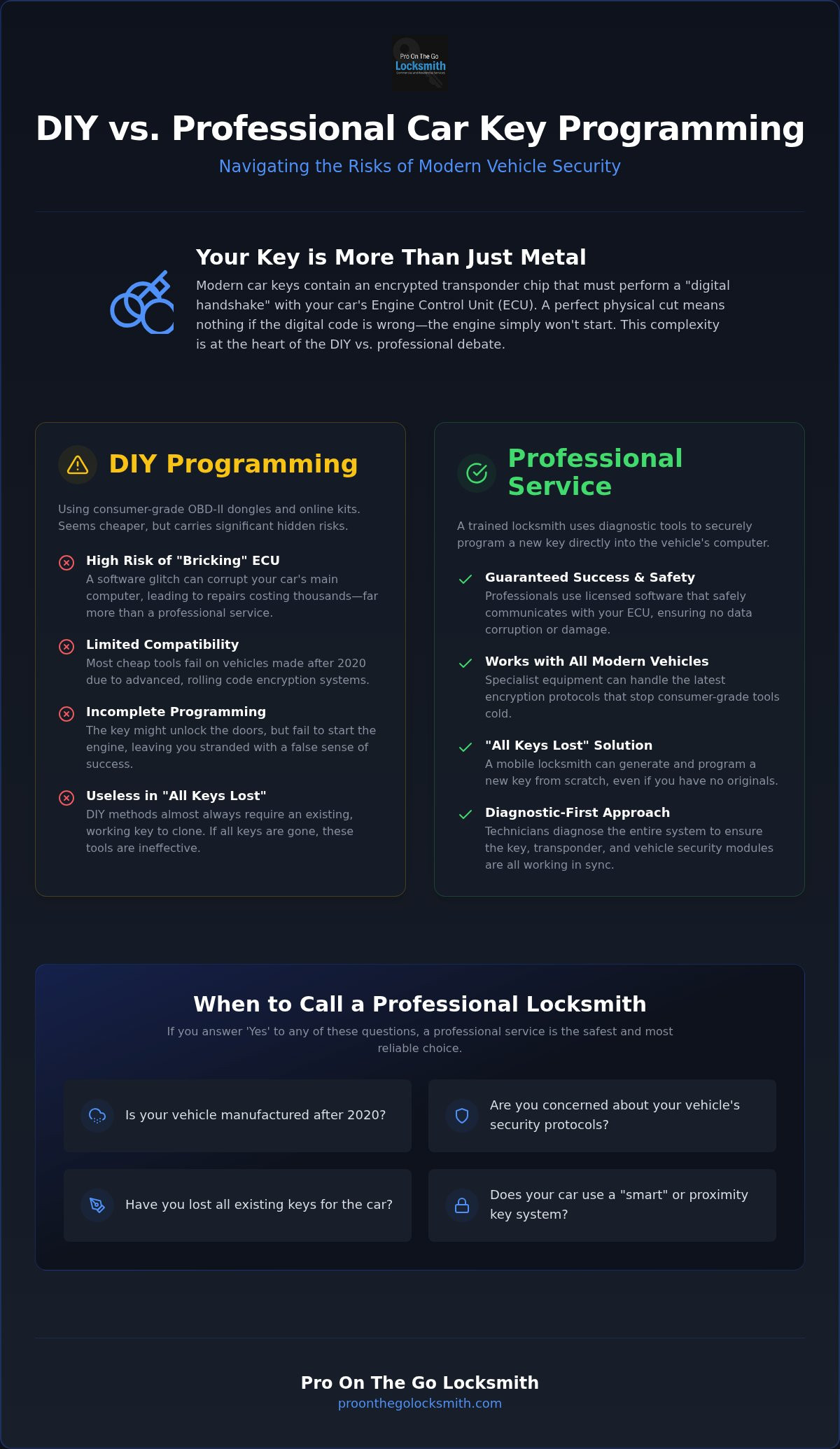
Decision Matrix: When to DIY vs. When to Call a Locksmith
Choosing between DIY vs professional car key programming often comes down to one specific factor: do you still have a working key? If you are in an "All Keys Lost" situation, the DIY option is almost certainly off the table. Most consumer-grade tools require an existing, programmed key to "unlock" the security module before a second key can be added. Without that initial handshake, the car's computer stays locked. This is where the expertise of a mobile technician becomes a necessity rather than an option. We have the specialized hardware to bypass these lockout states and generate a new master key from scratch.
Vehicle age also dictates your success rate. For cars manufactured before 2010, the security protocols were simpler; many used on-board programming sequences that required no tools at all. However, vehicles from 2020 and newer are equipped with secure gateway modules. These systems require authorized credentials to access, which are generally only available to licensed professionals or dealerships. If you value your time, consider that a professional can often complete the entire process on-site in under thirty minutes. A DIY attempt might take hours of troubleshooting, only to end in a "failed to communicate" error message. When evaluating DIY vs professional car key programming, the certainty of a working result often outweighs the small savings of a kit.
The 'Hard No' Scenarios for DIY
Certain vehicles require more than just a plug-in tool. Luxury brands like BMW, Mercedes-Benz, and Audi utilize high-level encryption that most retail kits cannot bypass. Beyond that, some models require EEPROM or "bench" programming. This involves removing a specific module from the car and soldering a connection directly to the chip to read its data. This is a high-precision task that leaves no room for error. If your vehicle falls into these categories, you should prioritize a specialized mobile car key replacement service to avoid permanent hardware damage.
The Professional Advantage
A professional locksmith brings more than just a tool; they bring a mobile lab. We utilize proprietary, dealer-level diagnostic software that receives regular updates to match the latest vehicle security patches. We also carry specialized machinery to provide precision "laser-cut" keys on-site, which are common on modern high-security vehicles. Most importantly, a professional provides a guarantee. If the programming fails or the key stops working in a week, you have a partner who will make it right. If you want the security of a guaranteed result, contact us for expert All Keys Lost Solutions and get back on the road today.
Professional Key Programming in Tampa: The Pro On The Go Advantage
Tampa drivers face a unique set of challenges, from the high-tech security of modern vehicles to the environmental wear caused by Florida's humidity. While the debate over DIY vs professional car key programming often centers on cost, local residents trust Pro On The Go Locksmith because we provide a licensed, mobile solution that eliminates the risk of error. Operating under Florida license #HCLOC23013, our technicians bring the expertise of a modern master technician directly to your driveway. We don't just sell a key; we provide a verified security restoration that ensures your vehicle remains protected and functional.
Our "Diagnostic-First" philosophy sets us apart from generic services and basic DIY kits. Before we attempt to sync a new transponder or smart fob, we perform a health check on your vehicle's security modules. This step is vital because a key that won't program is often a symptom of a deeper issue, such as a failing battery or a mechanical fault. In many cases, what seems like a programming error is actually a hardware problem requiring car ignition repair to resolve. By identifying these issues early, we prevent the frustration of failed DIY attempts and ensure a first-time fix.
Our Mobile Programming Process
When we arrive at your location, we deploy a fully equipped mobile lab designed for high-precision automotive work. The process follows a strict protocol to maintain your vehicle's security integrity. We begin by verifying ownership and analyzing the vehicle's specific encryption level. Using state-of-the-art diagnostic tools, we establish a secure, hardwired connection to the ECU. This stable link allows us to sync your new key safely, avoiding the data corruption risks associated with low-cost Bluetooth dongles. Once the programming is complete, we verify every function, from the remote start to the emergency mechanical blade, ensuring the result meets professional standards.
All-Keys-Lost Solutions in Tampa
Losing every single key to your vehicle is a high-stress scenario where DIY methods almost always fail. We specialize in these complex "All Keys Lost" situations by combining mechanical skill with digital expertise. Our technicians can decode your door lock to generate a new mechanical cut before beginning the digital synchronization process. This comprehensive approach saves you the significant expense of towing your vehicle to a dealership and waiting days for a replacement. We provide a streamlined, on-site resolution that gets you back behind the wheel with a fully functional security system.
Choosing between DIY vs professional car key programming is a decision between a gamble and a guarantee. We provide the transparency, technical precision, and localized service that Tampa drivers deserve. If you are ready for a secure, professional result without the dealership price tag, Contact Pro On The Go Locksmith for Expert Programming in Tampa and let our master technicians handle the rest.
Secure Your Vehicle's Future with Professional Precision
The choice between DIY vs professional car key programming involves more than just a price tag; it's about the integrity of your car's digital security. Modern vehicles rely on sophisticated encryption that leaves very little room for error. A single software mismatch or a dropped connection from a consumer-grade tool can lead to a bricked ECU, turning a simple task into a major mechanical repair. By prioritizing a specialist, you ensure that your vehicle's security modules are handled with the precision and diagnostic oversight they require for long-term reliability.
Pro On The Go Locksmith provides the technical expertise and mobile convenience Tampa drivers need to bypass the dealership. As a Licensed Florida Locksmith (#HCLOC23013), we specialize in high-security and smart key systems. We offer on-site service, which means no towing is required to get your vehicle back on the road. We verify every digital handshake and mechanical cut before we consider the job finished.
Get Professional Mobile Key Programming in Tampa Today and protect your vehicle with a master technician's touch. Your security is our priority, and we're ready to help you move forward with a plan that works.
Frequently Asked Questions
Can I program a car key fob myself without the original?
No, you generally cannot program a new fob yourself if you have lost all original keys. Most consumer-grade tools require an existing, functional key to unlock the vehicle's security module for the programming state. If you have zero working keys, a professional locksmith must use specialized software to access the car's computer directly. This allows the technician to generate a new master key from scratch without needing the original.
What happens if I use the wrong DIY programming tool on my car?
Using an incompatible tool can trigger a permanent security lockout or corrupt the data in your vehicle's immobilizer module. If the tool sends an unrecognized command, the car's computer may assume a theft attempt is underway and disable the ignition entirely. This often results in a no-start condition that requires a professional reset or even a hardware replacement to resolve the communication error.
How much does a professional locksmith charge for key programming in Tampa?
Professional programming costs in Tampa vary based on the vehicle's year, make, and the complexity of the security encryption. While locksmiths are typically more affordable than dealerships, the final investment depends on whether you have an existing key or require an All Keys Lost solution. We provide transparent quotes based on your specific vehicle's diagnostic requirements to ensure there are no hidden surprises or unnecessary fees.
Do I need to tow my car to the dealership for key programming?
No, you do not need to tow your vehicle if you choose a mobile locksmith service. Towing adds unnecessary expense and logistical headaches to an already stressful situation. A mobile technician arrives at your location in Tampa with a fully equipped lab to perform the programming on-site. This convenience saves you time and ensures your vehicle stays safely in your driveway while the work is completed.
Will an aftermarket key fob from Amazon work with my car?
It is possible, but aftermarket fobs carry a high risk of failure due to hardware inconsistencies. Many online fobs use cheaper internal chips or the wrong radio frequency, such as 315MHz instead of 433MHz. When comparing DIY vs professional car key programming, the reliability of the hardware is just as important as the software. If the fob is poor quality, it may stop working within days or fail to sync entirely.
Can a locksmith program a key that I already bought online?
Yes, many locksmiths can attempt to program a key you purchased yourself. However, most professionals cannot guarantee the performance of owner-supplied hardware. If the chip inside is defective or incompatible with your specific module, you may still be responsible for the service fee even if the key fails to sync. It is usually more reliable to source the key directly from the technician to ensure a full warranty.
How long does it take for a professional to program a new car key?
A professional can typically complete the programming process in 15 to 30 minutes. This timeframe includes the initial security diagnostic, the digital handshake with the ECU, and a full verification of the remote's functions. Some luxury brands with higher encryption may take slightly longer; however, the process is significantly faster than the hours often required for troubleshooting a DIY kit that refuses to communicate with the car.
Is it possible to 'brick' my car's computer by trying to program a key?
Yes, "bricking" your car's computer is a legitimate risk when weighing DIY vs professional car key programming. If a low-quality tool crashes during a data write to the Engine Control Unit, it can corrupt the operating software. This leaves the vehicle unable to communicate with its own systems. Fixing a bricked ECU often requires a complete module replacement, which is a far more expensive outcome than the initial cost of professional service.