
Car Key Not Working? A Diagnostic Guide to Modern Vehicle Access

What if that unresponsive key fob isn't actually a hardware failure, but a digital lockout triggered by your car's own security system? It's a frustrating moment when you're ready to leave but your vehicle refuses to acknowledge your presence. You're likely staring at your remote and feeling that familiar spike of anxiety over potential towing fees and dealership markups. We understand that a car key not working feels like a direct threat to your schedule and your wallet. It's confusing to determine if you just need a simple battery or a sophisticated computer resync.
This diagnostic guide will help you identify the root cause of your access failure so you can restore your mobility without a trip to the service department. You'll learn the specific signs of transponder errors, how modern 128-bit encryption affects your remote's performance, and why professional mobile programming is often the most efficient solution. We'll walk through the step-by-step process of troubleshooting your hardware before explaining how a technician can perform high-level OBD-II diagnostics on-site to get you moving again today.
Table of Contents
Why Your Car Key Is Not Working: Common Causes and Symptoms
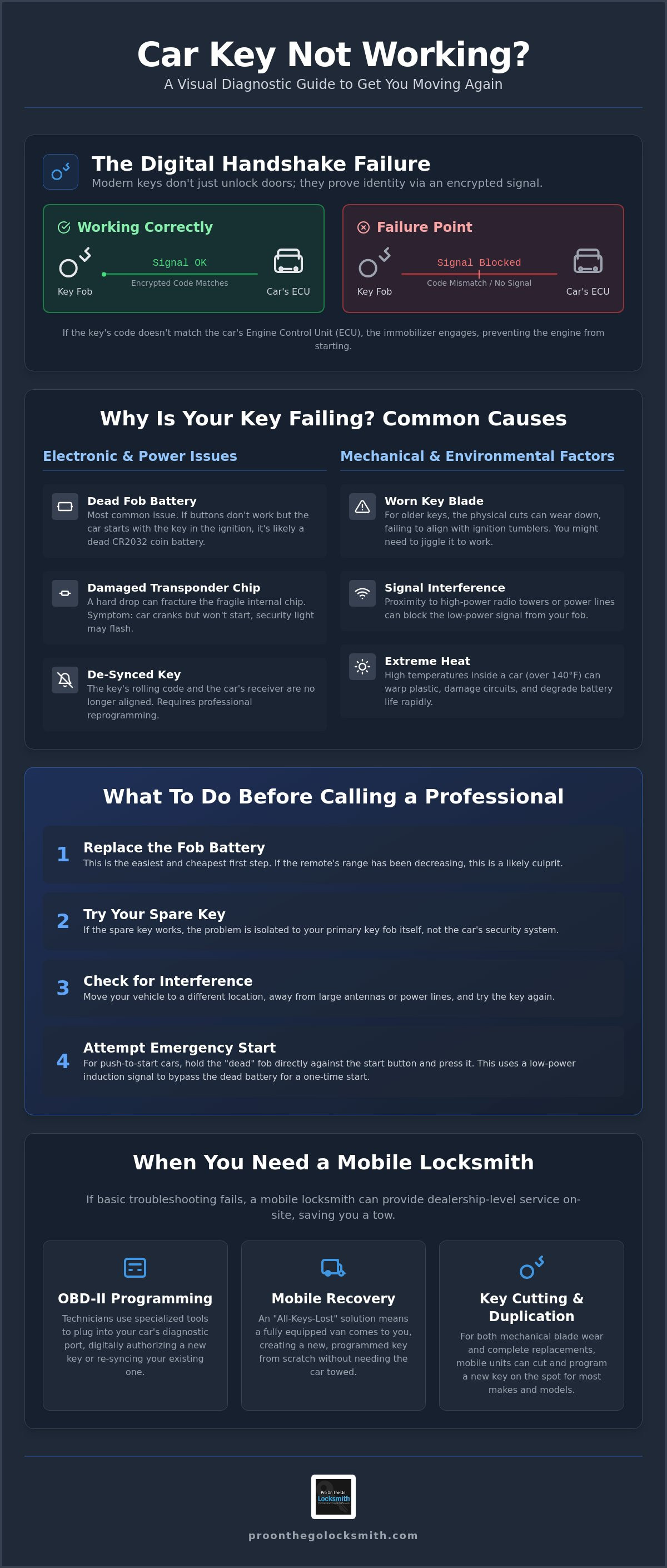
A car key failure is rarely just a mechanical issue. In most modern vehicles, a car key not working occurs when the security system fails to recognize the encrypted signal from the key or fob. This digital handshake is the foundation of vehicle security. If the code transmitted by your key doesn't match the expectation of the car's Engine Control Unit (ECU), the vehicle will remain immobilized. Identifying whether the problem is a simple power issue or a deeper software failure is the first step in restoration.
It's important to distinguish between a dead remote battery and a damaged transponder chip. If your buttons won't unlock the doors but the car starts when the key is in the ignition, you're likely dealing with a depleted CR2032 or similar coin-cell battery. However, if the car cranks but refuses to fire, or if a "security" light flashes on the dashboard, the transponder chip inside the key may be damaged or de-synced. These chips are fragile. A single hard drop can fracture the internal antenna, rendering the key invisible to the vehicle even if the battery is brand new.
The immobilizer acts as the car's digital gatekeeper, halting the engine's fuel or ignition systems if it doesn't receive the correct authorization code. This system is incredibly effective at preventing theft, but it can't distinguish between a thief and a legitimate owner with a malfunctioning key. Physical wear also plays a role, especially in older models. A metal blade that has been used for years will eventually lose its sharp peaks and valleys. If you find yourself needing to jiggle the key or pull it back slightly to get the ignition to turn, the mechanical tolerances have likely failed.
Electronic Failure vs. Mechanical Damage
Modern Smart key systems rely on complex internal circuit boards that are sensitive to environmental stress. Drops, heavy keychains, or even minor moisture exposure can cause micro-cracks in the solder joints. These failures are often intermittent at first. You might notice the key works on the third or fourth try before it fails entirely. In contrast, mechanical damage is usually obvious. A worn key blade will feel "sticky" in the lock cylinder. If the physical cuts on the blade no longer align with the wafers inside the ignition, the lock will stay trapped in the "off" position to protect the vehicle.
Environmental and Signal Interference
External factors frequently cause a car key not working scenario. High-voltage power lines or proximity to large cell towers can occasionally saturate the radio frequency (RF) environment, blocking the low-power signal from your fob. Florida drivers face the additional burden of extreme heat. When interior car temperatures exceed 140 degrees, the plastic housing of a fob can warp and the internal battery chemistry can degrade rapidly. If your vehicle won't acknowledge the key even when you're standing right next to it, you might need to explore car key not detected troubleshooting steps to see if the issue lies with the vehicle's receiving antenna or the key itself.
Decoding Modern Key Technology: Transponders and Smart Fobs
The transition from simple metal blades to encrypted security tokens changed the landscape of vehicle access. A modern key is essentially a mini-computer. It doesn't just physically turn a lock; it participates in a complex digital conversation with your car's security module. If your car key not working despite looking physically intact, the issue is likely a breakdown in this encrypted dialogue. Security is no longer about the shape of the metal, but the integrity of the data stored on the internal chip.
Transponder keys use a process called induction to operate without a large internal battery for the security chip itself. When you insert the key into the ignition, an induction coil surrounding the lock cylinder creates a small electromagnetic field. This field generates enough power for the passive RFID chip inside the key to transmit its unique code. Without this power transfer and subsequent code verification, the vehicle's computer will refuse to engage the fuel pump or starter. It's a precise, fail-safe method designed to stop hot-wiring, but it means a tiny internal component failure can leave you stranded.
The Anatomy of a Transponder Key
Most vehicles manufactured after 1995 utilize transponder technology to verify ownership. Early systems used "fixed codes" that stayed the same every time you started the car, but these were vulnerable to signal grabbing. Modern security relies on "encrypted rolling codes" that change with every single use. This ensures that even if a thief intercepts the signal, the code is already expired by the next attempt. This complexity is exactly what is a transponder key at its technical core: a dynamic security credential that requires perfect synchronization with the vehicle's ECU.
Smart Keys and Push-to-Start Systems
Smart keys utilize a "handshake" protocol involving two different radio frequencies. Your car constantly broadcasts a low-frequency (LF) signal to "ping" for the key. When the fob enters this range, it wakes up and responds with an ultra-high-frequency (UHF) signal containing the encrypted authorization. If you see a "key not detected" message on your dashboard, this handshake has failed. This failure often stems from signal interference or a corrupted FCC ID. Every replacement remote must have an FCC ID that matches the specific receiver installed in your vehicle to ensure the frequencies align perfectly.
Even with this high-tech circuitry, your remote still contains a hidden mechanical key blade tucked inside the housing. This manual override allows you to unlock the door if the fob's battery dies or the electronic system fails. If you find your car key not working and the electronics are unresponsive, using this blade is the first step to gaining entry. For a permanent resolution, we recommend professional key fob programming to resync your digital credentials and restore full functionality.
Programming vs. Cutting: Why a New Battery Isn't Always the Fix
Many drivers assume that a fresh battery solves every remote failure. If you've swapped the cell and still find your car key not working, you're likely facing a deeper software desynchronization or a hardware-level chip failure. Restoring access to a modern vehicle is a two-step process that requires both mechanical milling and digital authorization. Simply having a key that fits the lock is no longer enough to operate the vehicle; the car's computer must explicitly permit that specific key to engage the ignition system.
Most vehicles built after 2010 require professional-grade OBD-II diagnostic tools to facilitate this communication. These tools plug directly into the car's data port to "introduce" the new key to the immobilizer system. This level of access is necessary because the security protocols are designed to be impenetrable to anyone without specialized equipment. Attempting to bypass these systems with "self-programming" hacks found on the internet is risky. These methods often involve complex sequences of door cycles and ignition turns that are easily botched. In the worst cases, unauthorized software or incorrect sequences can "brick" your Engine Control Unit (ECU), turning a simple key replacement into a multi-thousand dollar computer repair.
The Professional Programming Process
A professional technician does more than just make the remote buttons work. Programming is a software-level handshake between key and car. During this session, the locksmith can access the vehicle's memory to clear out any lost or stolen keys. This is a critical security step; it ensures that even if a previous key is found by a stranger, it will no longer start your engine. We then sync the remote's rolling code with the car's receiver, verifying that the encrypted data matches perfectly for every future start attempt.
Laser-Cutting and Precision Milling
Physical precision remains vital for the longevity of your vehicle's hardware. High-security "sidewinder" keys feature a distinct, snake-like groove milled into the center of the blade rather than traditional notches on the edge. These require specialized laser-cutting machines that operate with micrometer accuracy. This level of precision prevents premature wear on your ignition cylinder. A poorly cut key creates friction and tiny metal burrs that eventually destroy the delicate internal wafers of the lock. For a detailed breakdown of how these tools are used in the field, see our mobile car key replacement guide. If your car key not working is due to physical resistance in the lock, a precision-milled replacement is often the only way to avoid a full ignition replacement.
Diagnostic Steps: What to Do Before Calling a Professional
Discovering your car key not working is a high-stress event, but a methodical approach can often reveal a simple solution. Before you commit to a replacement, perform a basic diagnostic sweep to isolate the failure. Start by inspecting the battery. Most modern fobs use a CR2032 or CR2025 coin-cell battery. Open the casing carefully and check the metal contacts for oxidation or debris. Even a thin layer of dust can interrupt the low-voltage circuit required to transmit your authorization code. If the battery is fresh, check your vehicle's fuse box. A blown fuse related to the central locking system or the security module will prevent the car from responding to any signal, regardless of the key's health.
If your remote is completely unresponsive, try the "Emergency Start" method. Most push-to-start vehicles are designed with a failsafe for dead fobs. Hold the key fob directly against the start button while pressing it. This proximity allows the vehicle's induction coil to power the transponder chip even if the fob battery is exhausted. Finally, test your spare key. If the spare starts the car immediately, you've confirmed the issue is isolated to the primary key hardware. If neither key works, the problem likely lies within the vehicle's immobilizer antenna or the ignition system itself.
Is the Problem the Key or the Ignition?
Distinguishing between a key failure and a mechanical ignition fault is vital for choosing the right repair. If your key is a traditional metal blade and it refuses to turn in the cylinder, the internal wafers are likely stuck or worn. This is a mechanical failure of the lock, not a digital error. However, if the key turns smoothly but the engine doesn't crank, or the dashboard displays a "security" icon, the car isn't recognizing the transponder's digital signature. A failing ignition switch often presents with flickering dashboard lights or accessories that lose power intermittently while driving. If you're locked out and these DIY steps don't resolve the issue, our professional car lockout service provides the diagnostic tools to identify the fault on-site.
Quick Fixes for Common Fob Issues
Internal button fatigue is a frequent culprit for intermittent failures. You can often restore functionality by opening the fob and cleaning the circuit board contacts with a cotton swab dipped in high-percentage rubbing alcohol. This removes the oily residue that builds up over years of use. Additionally, check the battery clips. These small metal tabs can lose their tension over time, leading to a loose connection. Gently bending them back into a position that applies more pressure to the battery can solve many "dead" fob problems. Stop your DIY efforts if you see cracked solder joints or physical damage to the circuit board. Forcing a repair on a fragile board can lead to permanent data loss. If these steps don't get you back on the road, contact us for expert car key replacement to ensure your vehicle's security system is professionally restored.
Mobile Recovery in Tampa: The All-Keys-Lost Solution
Mobile recovery is the definitive solution when your diagnostic efforts fail and the vehicle remains unresponsive. If you're stuck in a parking lot with a car key not working, the last thing you need is the logistical headache of a tow truck. Our mobile service eliminates that step entirely. We bring a fully equipped diagnostic lab directly to your location in the Tampa Bay area. This allows us to handle 'All-Keys-Lost' scenarios, which is a specialized protocol used when no original key is available to copy. Instead of simple duplication, we use high-level software to generate a fresh digital identity for your vehicle on-site.
Before we initiate the programming sequence, we require strict verification of ownership. This isn't just a formality; it's a security protocol that protects you and the integrity of your vehicle. We'll ask to see a valid ID and your vehicle registration before we interface with the car's computer. This transparency ensures that we're providing access only to the rightful owner. It's this methodical, professional boundary that separates a specialized technician from a generic service provider. Once verified, we use professional-grade tools to read the vehicle's security data and authorize a new set of encrypted keys.
The Advantage of Local Expertise
Hiring a licensed professional is vital for modern vehicle security. Pro On The Go Locksmith operates under Florida License #HCLOC23013, providing an level of accountability that unlicensed "handymen" can't match. While a dealership often requires a scheduled appointment days in advance, our mobile units are designed for rapid response. We perform on-site ignition repair and transponder programming in a single visit. We carry a wide inventory of fobs and smart keys for the latest models, ensuring we have the hardware necessary to resolve your car key not working situation without waiting for backordered parts from a factory.
Restoring Your Security and Peace of Mind
A significant benefit of our mobile service is the ability to manage your vehicle's entire key memory. If your key was lost or stolen, we can erase all previous digital signatures from the car's ECU. This means that even if a stranger finds your old key, it will no longer be able to start the engine. We follow a strict verification process before we leave: testing the door locks, the trunk release, and the ignition start multiple times. If your situation involves physical damage, such as a key broken in car door lock recovery, we perform the extraction and the digital programming in one seamless workflow. You'll have a fully functional, secure vehicle and the confidence that your mobile access is completely restored.
Restore Your Vehicle Access with Professional Precision
Modern vehicle security is a complex ecosystem where digital encryption and mechanical precision must align perfectly. You now understand that a car key not working is often a software-level synchronization error rather than a simple hardware failure. By utilizing the diagnostic steps we've covered, such as testing your spare or using the emergency start method, you can quickly determine if the fault lies with the key or the car's internal computer.
If these troubleshooting efforts don't get you moving, you don't need to worry about the high costs and delays of a dealership tow. Pro On The Go Locksmith provides specialized on-site programming for most makes and models throughout the Tampa area. As a licensed Florida locksmith (#HCLOC23013), we bring professional-grade diagnostic equipment directly to your location. We handle everything from precision milling to complex transponder authorization right where your vehicle sits. Don't let a technical glitch derail your schedule. Get Fast Mobile Key Replacement in Tampa - Call Pro On The Go Locksmith Now. We're here to provide the reliable, expert support you need to get back on the road today.
Frequently Asked Questions
Can I program a new car key fob myself at home?
You can rarely program a modern car key fob yourself without specialized diagnostic equipment. While some older vehicles allow manual sequences involving door locks and ignition turns, most cars built after 2010 require a direct connection to the OBD-II port to authorize a new digital signature. Attempting DIY programming with unverified software can lead to expensive errors in your vehicle's security module or even a complete system lockout.
How much does it cost to replace a high-security automotive key?
The cost to replace a high-security key varies based on your vehicle's make, model, and the sophistication of the internal transponder chip. Factors like laser cutting for sidewinder blades and the complexity of rolling code encryption influence the final investment. Choosing a mobile locksmith is typically more cost effective than a dealership because you avoid the expense of a vehicle tow and dealership service markups.
Do I need to tow my car to the dealership if the key is not working?
You do not need to tow your car to a dealership if you find your car key not working. A mobile locksmith carries the same high-level diagnostic computers found at service centers and can perform all necessary programming on-site. This mobile approach saves you the time and expense of hiring a tow truck while restoring your vehicle access exactly where the car is parked.
What is the difference between a transponder key and a regular remote?
A transponder key contains a passive RFID chip that communicates with the vehicle's immobilizer to start the engine. In contrast, a regular remote only controls the central locking system to lock or unlock the doors. Many modern fobs combine both technologies into a single unit; however, it's possible for the remote buttons to work while the transponder fails to authorize the ignition or vice versa.
Can a locksmith replace a smart key with push-button start?
Yes, a specialized automotive locksmith can replace and program smart keys for push-button start systems. We utilize advanced software to sync the new proximity fob with your vehicle's receiver, ensuring the handshake protocol functions correctly. This process involves clearing old key data from the car's memory and authorizing the new hardware to ensure your vehicle remains secure and responsive to the new digital signature.
How long does it take for a mobile locksmith to make a new car key?
A mobile locksmith can typically generate and program a new car key in 20 to 60 minutes once they arrive at your location. The exact timeframe depends on the complexity of the vehicle's security system and whether a physical blade needs laser cutting. This efficient on-site service allows you to return to your schedule much faster than waiting for a dealership service appointment or a tow truck.
Will getting a key from a locksmith void my car's manufacturer warranty?
Getting a replacement key from a professional locksmith will not void your car's manufacturer warranty. Federal laws, such as the Magnuson-Moss Warranty Act, protect consumers' rights to use independent service providers for maintenance and parts. As long as the programming is performed correctly using compatible hardware, your vehicle's warranty coverage remains fully intact and unaffected by the addition of a new, professionally programmed key.
What information do I need to provide to get a replacement key made?
You must provide proof of ownership and specific vehicle details to have a replacement key generated. We require a valid government-issued ID and your vehicle's registration or title to verify you are the rightful owner. Additionally, providing the Vehicle Identification Number (VIN) allows us to identify the correct key blank and security protocols required for your specific car key not working situation.


