7 Warning Signs You Need a New Key Fob (Before You Get Stranded)

You're late for an appointment, your hands are full of bags, and you press the unlock button on your remote only for nothing to happen. You click it again, pressing harder this time, and finally hear that familiar chirp. It's easy to dismiss this as a minor fluke, but that intermittent response is often the first of several signs you need a new key fob before the hardware fails completely.
We understand the anxiety that comes with unpredictable vehicle access. You shouldn't have to wonder if your car will start every time you walk across a parking lot. By learning to identify these technical red flags early, you can take control of your security before a total lockout occurs. This article will help you determine if your remote just needs a fresh battery or if the internal circuitry is reaching its end of life.
We will walk you through seven specific warning signs and provide a clear path toward a professional solution. You'll learn how to diagnose your issue accurately and discover how a specialized locksmith can program a replacement for a fraction of the cost of a dealership visit.
Table of Contents
Understanding Modern Key Fob Technology and Why It Fails
A car key used to be a simple piece of cut metal. Today, your key fob is a sophisticated radio frequency (RF) transmitter that functions as the primary gatekeeper for your vehicle's security. It's part of a complex Remote Keyless System (RKS) that does much more than just unlock doors. Every time you press a button, the fob sends a unique, encrypted code to the vehicle's computer. If that code doesn't match perfectly, the engine immobilizer stays active, and you're going nowhere. While we often think of these as convenience items, they're actually high-tech security hardware. Understanding this helps identify the early signs you need a new key fob before you're stuck in a driveway with a car that won't recognize its owner.
Physical damage isn't the only way these devices fail. While a cracked casing or a missing button is obvious, software corruption is a silent killer for modern remotes. The internal memory that stores your vehicle's unique encryption keys can degrade over time. When this happens, the "handshake" between the fob and the car fails, even if the battery is brand new. This digital breakdown is just as common as a broken circuit board, making professional diagnosis essential.
Transponder vs. Smart Keys: What Is in Your Pocket?
Not all fobs operate the same way. Standard transponder keys rely on a small chip that must be physically near the ignition to deactivate the immobilizer. In contrast, "Smart" keys or proximity fobs use a continuous signal to allow for push-button starts and hands-free entry. These technologies face different failure points. A transponder key might fail if the internal chip is jarred loose or cracked. A smart key is more susceptible to signal interference and internal antenna degradation. Both systems are vulnerable to the same environmental stressors that cause the common signs you need a new key fob.
The Average Lifespan of an Automotive Fob
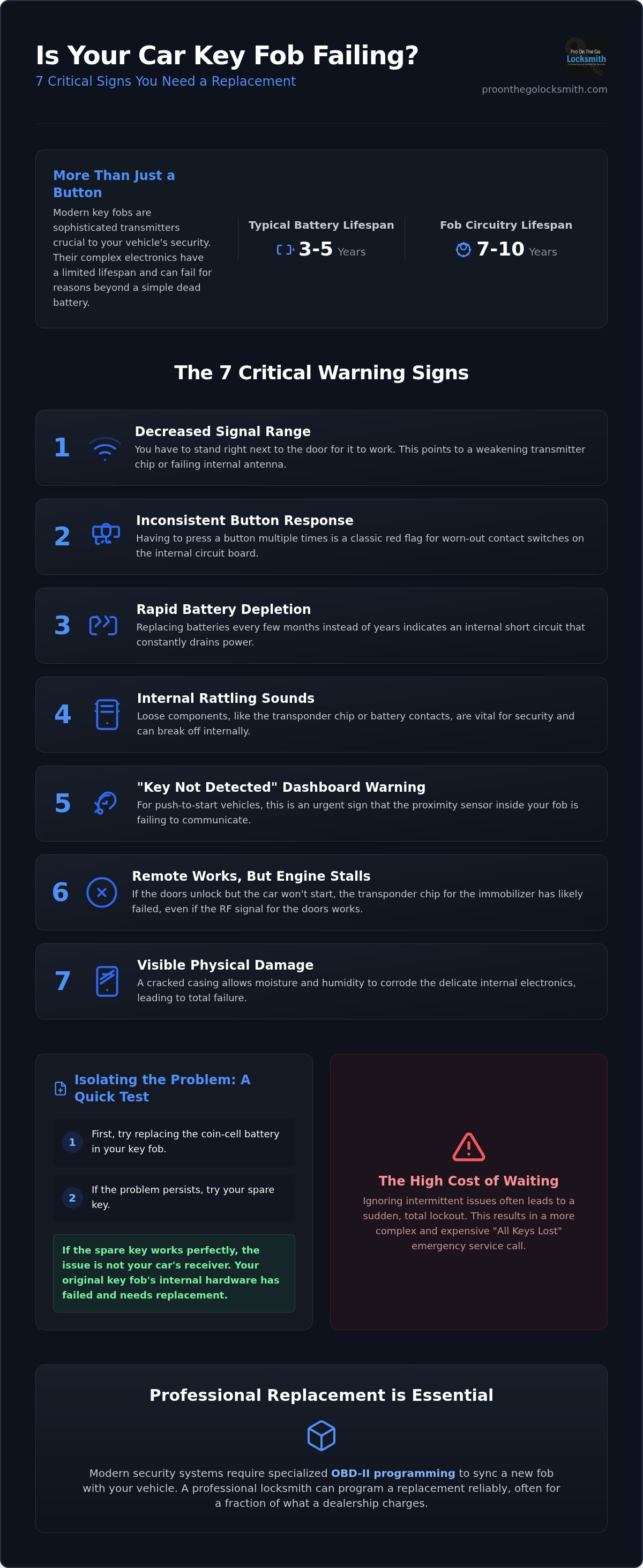
Most drivers expect their hardware to last as long as the vehicle, but that isn't always the case. A standard battery typically lasts 3 to 5 years; the internal circuitry generally has a lifespan of 7 to 10 years. In a coastal environment like Tampa, these timelines often shrink. High humidity and intense heat can accelerate the oxidation of internal circuit boards and cause rubber button membranes to swell or tear. This leads to the physical and digital breakdown of the device. Planned obsolescence in automotive security refers to the design of electronic components that are intended to be replaced rather than repaired after a specific period of use.
7 Critical Signs You Need a New Key Fob Today
Identifying the signs you need a new key fob early is the best way to avoid an emergency lockout. Modern fobs are complex devices, and according to Consumer Reports, their hidden features and sophisticated electronics mean that failure isn't always as simple as a dead battery. If you notice any of these symptoms, your vehicle's security system is likely trying to warn you of an impending failure.
Decreased Signal Range: You used to be able to unlock your car from across the street. Now, you have to stand right next to the driver's side door for the signal to register. This indicates a weakening transmitter chip or a failing internal antenna.
Inconsistent Button Response: Having to press "Unlock" or "Start" multiple times before the car reacts is a classic diagnostic red flag. While this can sometimes be a battery issue, it often points to worn-out tactile switches on the circuit board.
Rapid Battery Depletion: If you find yourself replacing the coin-cell battery every few months instead of every few years, the fob has an internal short. A healthy circuit board shouldn't drain power that quickly.
Internal Rattling: Any sound of loose components when you shake the fob suggests that the transponder chip or battery terminals have detached. These small parts are vital for the "handshake" between the fob and the immobilizer.
The "Key Not Detected" Warning: For push-to-start vehicles, this dashboard message is the most urgent warning. If it appears while the key is in your pocket, the proximity sensor inside the fob is failing.
Remote Works, Engine Stalls: If your buttons unlock the doors but the car won't start, the transponder chip is likely damaged. The car recognizes the RF signal for the doors but fails to verify the security code for the ignition.
Visible Physical Damage: Cracked casings allow moisture and Tampa's high humidity to seep into the electronics. Once corrosion starts on the terminals, a total failure is inevitable.
If your device exhibits these behaviors, seeking a professional Car Key Replacement is a proactive step that saves you from the stress of a stranded vehicle.
Hardware Failures: Buttons and Casings
Physical wear is often the catalyst for electronic failure. Over time, the tactile switches beneath the rubber buttons can collapse or become desoldered from the circuit board. This leads to "ghost presses," where the fob sends signals without you touching it, or a complete lack of response. Furthermore, a cracked casing isn't just an aesthetic issue. It breaks the protective seal, leading to terminal corrosion that eventually destroys the entire unit.
Communication Errors: Transponder and Signal Issues
Digital communication errors are harder to spot but just as critical. Signal interference from other electronic devices can mimic a failing fob, but persistent issues usually point to a degraded transmitter. Troubleshooting the car key not detected error on your dash requires a methodical approach. If the battery is fresh and the error remains, the internal chip has likely lost its synchronization with the vehicle's computer, requiring professional reprogramming or a full unit replacement.
Diagnostic Phase: Is It a Dead Battery or a Damaged Fob?
Before you commit to a full replacement, you must determine if the failure is power-related or structural. The "Spare Key Test" is the most effective way to isolate the problem. If your backup remote operates the vehicle perfectly, you've confirmed that the car's receiving antenna and computer are functioning correctly. This confirms that the issues you're experiencing are specific signs you need a new key fob rather than a larger electrical fault within the vehicle itself.
If you have a multimeter at home, you can perform a precision check on the battery. A standard CR2032 battery should read at least 3.0 volts. If the reading is 2.8 volts or lower, the battery is technically dead and cannot power the transmitter chip. However, if the battery tests well but the fob's small LED light fails to blink when buttons are pressed, the unit is likely "bricked." This indicates a total failure of the internal circuit board that a simple battery swap cannot fix.
Desynchronization is another common diagnostic hurdle. In this scenario, the fob has full power, but the vehicle no longer recognizes the encrypted rolling code. This often happens after the battery has been dead for an extended period or if the fob has been subjected to significant signal interference. While the hardware is technically "good," the software link is broken, requiring professional tools to resync the device to the immobilizer.
The 30-Second Battery Reset Trick
Minor software glitches can sometimes be cleared with a manual power cycle. Remove the battery and hold down any button on the remote for 30 seconds to fully drain the internal capacitors. When you reinsert the battery, the fob's processor restarts from a clean state. Be careful during this process. A common mistake is using too much force and bending the fragile metal battery clips, which prevents a solid electrical connection. Always verify your battery type before purchasing a replacement; while CR2032 is the industry standard, many modern proximity keys require thinner CR2025 or CR1632 cells.
Internal Damage: What a Locksmith Sees
When we open a failing remote, we often find "cold solder joints." These are microscopic cracks in the silver solder that connects the transmitter chip to the green circuit board. They usually occur after years of being dropped or exposed to vibration. We also look for white, powdery residue, which is a clear indicator of water damage and mineral corrosion. If the internal architecture is compromised by these factors, a professional mobile car key replacement is the only reliable way to restore your vehicle's security. Trying to "clean" a corroded board is usually a temporary fix that leads to a total lockout later.
The Risks of Ignoring a Failing Fob
Ignoring the early signs you need a new key fob is a gamble that eventually leads to a total security system lockout. Many drivers assume they can simply rely on the manual emergency key blade tucked inside the remote. This is a risky misconception. In most modern vehicles, using the physical blade to open the door will trigger the factory alarm because the car hasn't received the "disarm" signal from the transmitter. Even worse, if your vehicle uses a push-button start, a failed fob means the immobilizer won't deactivate, leaving you with a car that recognizes the key is present but refuses to crank the engine.
There is also a significant financial penalty for procrastination. If you act while you still have one functioning remote, a technician can perform a simple duplication and sync. However, if you wait until the device fails completely, you enter an "All Keys Lost" scenario. This requires a more invasive technical process to pull security codes from the vehicle's ECU and reset the immobilizer, which is a much more complex and labor-intensive service than a standard backup. Proactively seeking Key Fob Programming while your current remote is still intermittent ensures you stay ahead of these technical hurdles.
Over-reliance on the manual key cylinder also creates mechanical wear. These cylinders are designed for emergency use, not daily operation. Forcing a rarely used lock can lead to a broken key or a seized cylinder, adding "Broken Car Key Extraction" or ignition repair to your list of necessary services. Finally, a malfunctioning circuit board can sometimes send "ghost signals" that unlock your vehicle while you're away, creating a massive security vulnerability that puts your belongings at risk.
Dealership vs. Mobile Locksmith: The Cost of Waiting
When a total failure occurs, the dealership is often the first place people call, but it's rarely the most efficient path. Dealerships typically require you to tow the vehicle to their service center, adding a towing fee to an already expensive programming bill. You are then at the mercy of their service schedule. A mobile locksmith provides a more logical solution by bringing the specialized OBD-II programming equipment directly to your location in Tampa. This on-site service eliminates the need for a tow truck and restores your access in a single visit, providing a high-tech restoration of your security system without the dealership's overhead.
Modern Anti-Theft Lockouts
Modern immobilizer systems are programmed to be highly sensitive. If the car detects a weak or corrupted signal from a failing transmitter chip multiple times, it may "hard lock" the security system as a theft-prevention measure. This makes the eventual repair even more technical. If you find yourself in an emergency situation where the fob isn't responding, follow this diagnostic checklist before calling for help:
The Proximity Press: Physically touch the key fob directly against the Start button while pressing it. Many cars have a backup induction coil that can read the chip even if the fob battery is dead.
Check the Hidden Slot: Some models have a specific slot in the center console or glove box designed to read fobs with weak signals.
Battery Orientation: If you recently swapped the battery, verify the positive (+) side is facing the correct direction; even a slight misalignment prevents the circuit from closing.
Professional Key Fob Programming and Replacement in Tampa
Once you identify the signs you need a new key fob, the next step is secure restoration. Many drivers try to save money by purchasing generic remotes from unverified online marketplaces. These "cheap" fobs frequently arrive with incorrect internal chips or locked software that refuses to sync with your car's computer. Attempting to program these yourself can sometimes trigger a security lockout, leaving the vehicle completely immobilized. Professional replacement ensures that the hardware is compatible with your specific make and model, preventing digital conflicts that lead to future failures.
Modern vehicle security requires more than just a new battery. Most cars manufactured after 2018 utilize encrypted rolling codes that can only be accessed through specialized OBD-II programming equipment. This hardware plugs directly into your vehicle's diagnostic port to "introduce" the new fob to the engine immobilizer. At Pro On The Go Locksmith, our process is thorough and methodical. We perform a full system sync and precision-cut the emergency manual blade using laser-guided equipment. This dual-layer approach ensures you have both a high-tech digital entry method and a reliable mechanical backup.
Choosing a professional service also provides a level of verification that DIY methods lack. We test every button and proximity sensor to confirm the signal strength meets factory specifications. This verification phase is critical for smart keys, where the "handshake" between the fob and the car must be instantaneous for push-button starts to function correctly. By choosing a specialized technician, you avoid the common pitfalls of "dead on arrival" parts often found in the aftermarket world.
Mobile Solutions for Tampa Drivers
The primary benefit of our service is mobility. You don't need to arrange a tow truck or wait for hours in a dealership lobby. Our technicians provide on-site service at your home, office, or wherever you happen to be in the Tampa area. We cover all major neighborhoods and surrounding communities, bringing a fully equipped mobile lab directly to your door. If your remote has already failed and left you stranded, we also provide a comprehensive car lockout service to get you back inside your vehicle safely before we begin the programming process.
Get a Reliable Replacement Today
Don't wait for a total system failure to address a dying remote. Proactive replacement is the most cost-effective way to maintain your vehicle's security. Pro On The Go Locksmith is fully licensed (Florida license #HCLOC23013) and insured, giving you peace of mind that your car's sophisticated electronics are in expert hands. We utilize the same high-level diagnostic technology found at major dealerships but deliver it with the speed and fair pricing of a local mobile specialist. If you've noticed the early signs you need a new key fob, contact us today to schedule a professional on-site replacement and ensure you're never left stranded.
Secure Your Vehicle Access with Professional Restoration
Your car's security system is only as reliable as the hardware in your pocket. Identifying the early signs you need a new key fob allows you to address technical degradation before it evolves into a total lockout. Whether you're dealing with inconsistent button response or a "Key Not Detected" warning, taking action now prevents the stress and added expense of emergency towing and complex immobilizer resets.
Pro On The Go Locksmith provides a sophisticated alternative to dealership delays. As a licensed Florida Locksmith (#HCLOC23013), we possess the specialized equipment required for precision smart key programming and all-keys-lost scenarios. We prioritize your time and safety by bringing our mobile lab directly to your location in Tampa, ensuring your vehicle's digital handshake is restored with expert accuracy.
Maintain your peace of mind by securing a reliable backup today. Our team is ready to provide the modern security solutions you need to stay on the move. Get a Professional Key Fob Replacement in Tampa Now
Frequently Asked Questions
Can I program a new key fob myself?
Onboard programming is only possible for older vehicles or specific models that allow manual sequence resets. Most modern cars produced after 2018 require specialized OBD-II diagnostic tools to sync the new hardware with the engine immobilizer. DIY attempts on these newer systems usually fail because the vehicle's security software is locked to prevent unauthorized access by anyone without professional equipment.
How much does it cost to replace a key fob in Tampa?
The total cost depends on your vehicle's make, model, and the complexity of its security chip. While we don't provide fixed pricing here, a mobile locksmith typically offers a more cost-effective solution than a dealership. We eliminate towing fees and high service center overhead. Contacting a specialist with your VIN is the most accurate way to receive a tailored quote for your specific car.
Why is my car saying "Key Not Detected" even with a new battery?
This message usually indicates a failure of the internal proximity sensor or a desynchronization of the rolling code. Even with a fresh battery, a "bricked" circuit board cannot transmit the necessary handshake signal to the car's computer. This is one of the most definitive signs you need a new key fob rather than just another battery swap.
Can a locksmith replace a push-to-start smart key?
Yes, a specialized automotive locksmith has the same programming technology as a dealership to handle proximity fobs and smart keys. We can clear old keys from the vehicle's memory and sync new ones on-site. This service includes laser-cutting the emergency physical blade that is hidden inside the smart fob casing for manual entry.
How long does it take for a locksmith to program a new fob?
Most programming procedures take between 15 and 30 minutes once the technician is on-site. Some luxury European models or complex "all keys lost" scenarios may require additional time to pull security codes from the ECU. Our mobile setup is designed for efficiency, ensuring you aren't waiting for hours in a dealership service lobby.
What should I do if my only key fob is lost or broken?
You should contact an automotive locksmith who specializes in "All Keys Lost" solutions immediately. We can generate a new digital signature for your vehicle and program a replacement even without an original key to copy. It is a much faster and less expensive process than having your car towed to a dealership for a full computer reset.
Is it cheaper to go to a locksmith or a dealership for a key fob?
A locksmith is almost always the more affordable option for vehicle owners. Dealerships often charge premium rates for the hardware and labor, and they require you to bring the car to them. A mobile locksmith saves you the cost of a tow truck and provides the same high-tech programming at a more competitive price point.
Will a new key fob need to be cut or just programmed?
Most modern fobs require both services to be fully functional. The electronic chip must be programmed to the immobilizer, and the internal emergency blade must be cut to match your door locks. Having both ensures that you can still enter the vehicle manually if the car battery dies or the electronic signal is blocked by interference.